



What Is Space Weather?
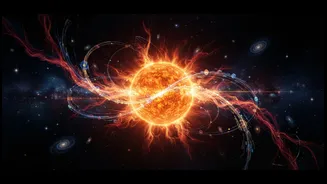
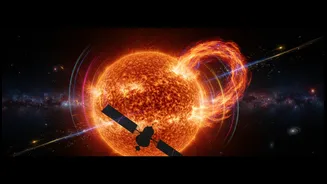
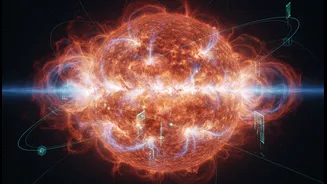
Space weather refers to the changing conditions in space driven by the Sun's activity. Unlike weather on Earth, it doesn't involve wind and rain. Instead, it’s about the constant stream of charged particles, known as the solar wind, and massive eruptions
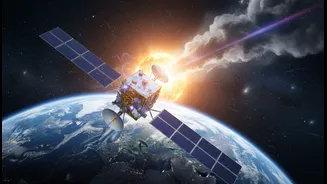
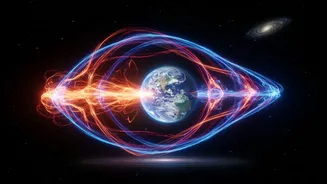
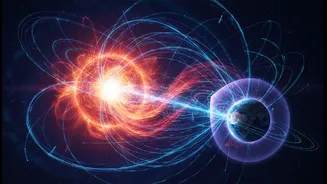
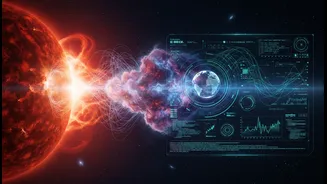
from the Sun like solar flares and coronal mass ejections (CMEs). These events send vast amounts of energy and matter hurtling through the solar system. While Earth's magnetic field acts as a protective shield, deflecting most of this solar onslaught, intense solar storms can breach these defences, interacting with our upper atmosphere and causing significant disturbances. These invisible storms are the focus of space weather scientists.
Why It Matters More Than Ever
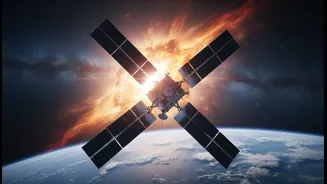
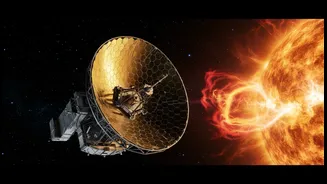
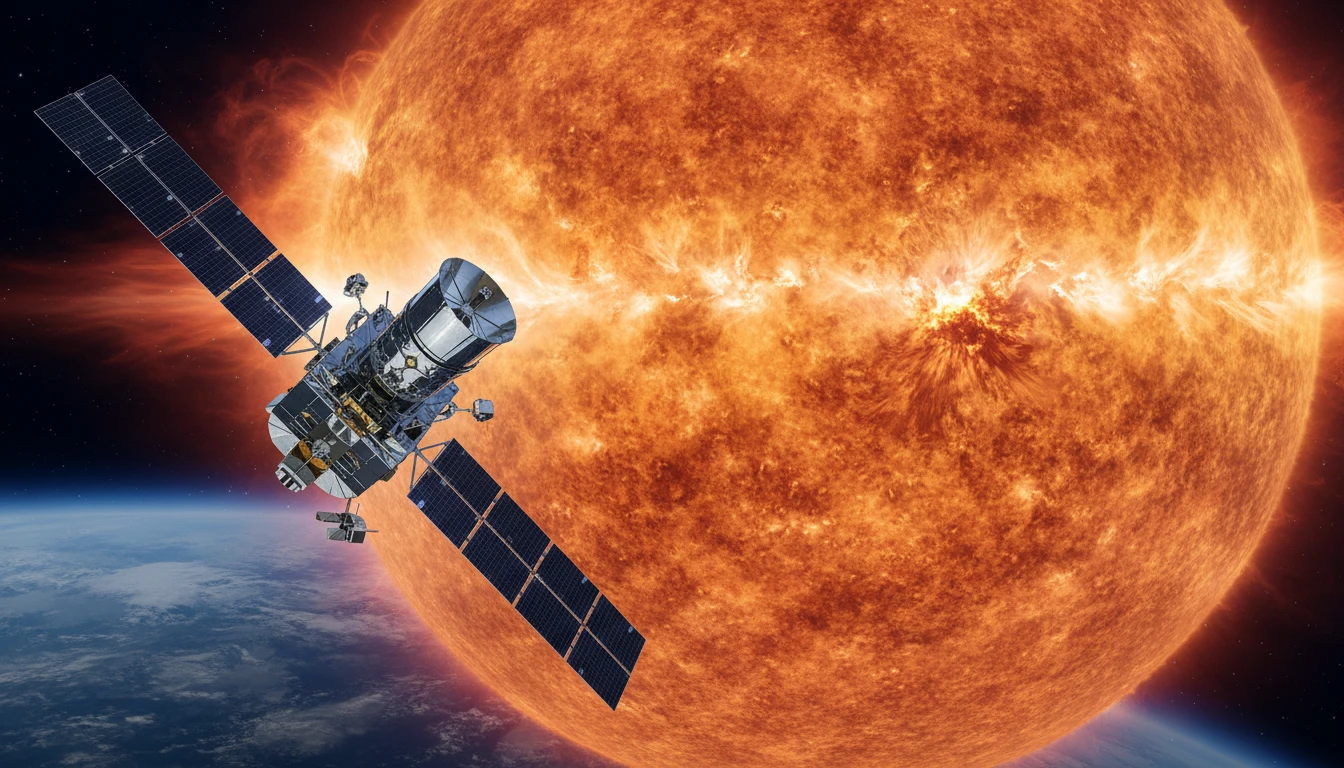
Our modern, technologically dependent society is increasingly vulnerable to space weather. Solar storms can damage satellite electronics, disrupt GPS and communication signals, and even induce powerful electrical currents in ground-based power grids, potentially causing widespread blackouts. For India, with its rapidly growing space sector and ambitious missions like Aditya-L1—the nation's first dedicated solar observatory—understanding and predicting space weather is a national priority. The Indian Space Research Organisation (ISRO) is actively studying solar phenomena to safeguard its crucial space assets and improve navigation services like NavIC. As our reliance on satellites for everything from banking to defence grows, so does the need for skilled professionals who can help forecast and mitigate the impacts of these cosmic events.
The Foundation: Physics
At its core, space weather is a story of physics. Understanding this field requires a strong grasp of fundamental principles, from the dynamics of plasma (ionized gas) that makes up the Sun and solar wind, to the complex interplay of magnetic fields. Physicists study how energy is transferred from the Sun to the Earth, why the Sun's corona is millions of degrees hotter than its surface, and what initiates dramatic events like CMEs. For students in India, a strong foundation in physics, often pursued through a B.Sc. or B.Tech in Physics or Engineering Physics, is the essential first step towards a career in this domain. This knowledge forms the basis for building the models that help predict the Sun's behaviour.
The Tool: Coding
In modern astrophysics, coding is the primary tool for analysis. The sheer volume of data collected by solar observatories like Aditya-L1 is impossible to analyse manually. Scientists and engineers use programming languages like Python to process this data, run complex simulations of solar events, and develop machine learning models for forecasting. These predictive models, often using neural networks, are being trained to identify patterns that precede solar flares or CMEs, offering valuable warning time. For students, gaining proficiency in programming is no longer optional; it's a core competency for a career in space science, enabling them to turn raw data into scientific insight.
The Insight: Data Visualisation
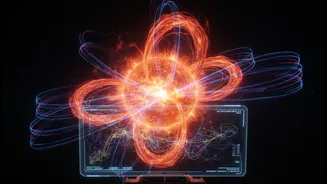
Raw data and code are not enough; the ability to visualize complex information is what leads to breakthroughs. Data visualisation transforms billions of data points into intuitive charts, maps, and 3D models that the human brain can interpret. Scientists create visualisations to track the structure of a CME as it travels through space, map the Earth's fluctuating magnetic field, or represent the density of particles in the ionosphere. These visual tools are crucial for identifying patterns, communicating findings to other scientists and the public, and making the invisible forces of space weather visible and understandable. For students, this skill bridges the gap between technical analysis and true comprehension.
Building Your Skills in India
For students in India aspiring to enter this field, the path begins with a strong focus on Physics, Chemistry, and Mathematics (PCM) in high school. This leads to undergraduate degrees like a B.Tech in Aerospace Engineering, Electronics, or Computer Science, or a B.Sc. in Physics. Premier institutions like the IITs, the Indian Institute of Space Science and Technology (IIST), and the IISERs offer specialized courses and research opportunities. Beyond formal education, students can build skills through online courses in Python and data analysis, participating in hackathons, and seeking internships with organisations like ISRO or other research institutes. Building a portfolio of projects is crucial to demonstrate practical ability. A postgraduate degree (M.Tech or PhD) is often necessary for advanced research roles.