




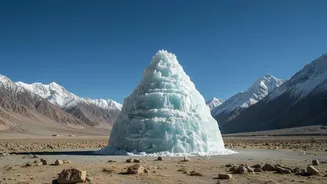
A Land of Icy Paradox
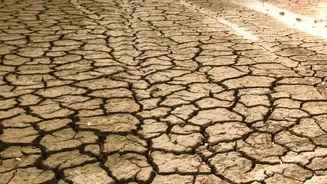
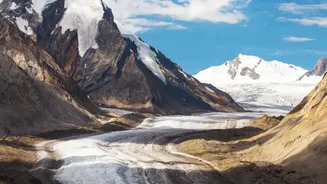
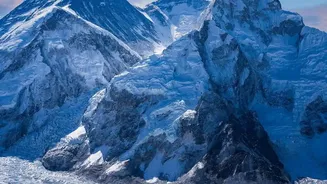
Ladakh is a land of stunning contradictions. A cold desert cradled in the Himalayas, it receives less than 50 millimetres of rain annually, making its communities almost entirely dependent on glacial melt for survival. For centuries, this rhythm worked.
But climate change is rewriting the rules. Glaciers are receding, and winter snows are less predictable. The most critical problem is one of timing. Much of the winter meltwater from lower altitudes flows away unused when farming is impossible, leaving streams dry during the crucial spring sowing months of April and May. Farmers would have to wait until June for the higher glaciers to start melting, a delay that could devastate their barley and apple crops.
The Birth of an Idea
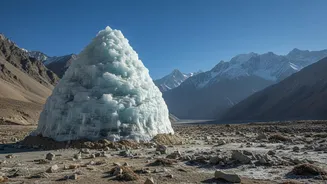
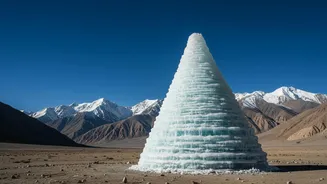
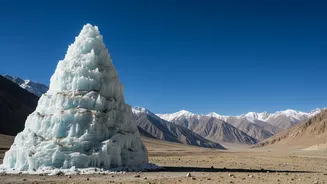
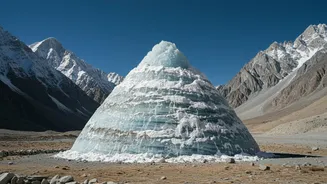
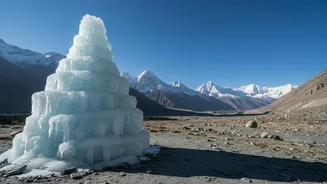
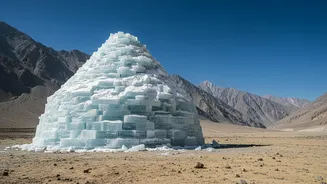
The solution came from local engineer and innovator Sonam Wangchuk. The idea was sparked by a simple observation: in late spring, he noticed ice still clinging to life under a bridge, shielded from the sun, long after other ice had melted. This led to a key insight: if ice could be protected from direct sunlight, it could last much longer. Building on earlier, less efficient attempts at creating artificial glaciers by others, Wangchuk envisioned a new approach. Instead of a flat field of ice with a large surface area, he imagined a vertical, cone-shaped structure that would minimize exposure to the sun, inspired by the sacred stupas dotting the Ladakhi landscape.
How to Build a Glacier
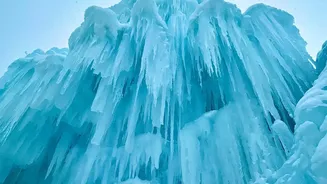
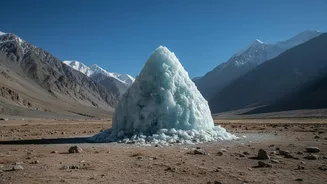
The engineering behind an ice stupa is remarkably simple and elegant, relying on gravity and the region's freezing temperatures. A pipeline is laid to carry water from a glacial stream at a higher altitude down to a village. The difference in elevation creates natural water pressure, with no need for electric pumps. At the end of the pipe, a sprinkler shoots the water vertically into the frigid winter air, which can drop below -20°C. The water freezes almost instantly as it falls, building up layer by layer around a basic frame. Over the winter months, this process creates a massive cone of ice, a veritable artificial glacier that can stand dozens of metres tall and store millions of litres of water.
The Genius of the Cone
The conical shape is the true genius of the ice stupa. Basic geometry dictates that a cone has the minimum surface area for a given volume. This means less of the ice is exposed to the sun's rays compared to a flat, horizontal sheet of ice. As a result, the ice stupa melts much more slowly. The first prototype, built in 2013, lasted until mid-May, well into the planting season, even as ambient temperatures rose above 20°C. This slow, steady release of meltwater provides farmers with the irrigation they desperately need precisely when they need it most, bridging the dangerous water gap between the end of winter and the start of summer.
From Concept to Lifeline
Since the first successful prototype, the ice stupa project, led by Wangchuk's NGO SECMOL, has grown significantly. Dozens of these artificial glaciers have been built across Ladakh, turning barren land green and securing livelihoods. They now provide millions of litres of water for irrigating crops like poplar, apple, and wheat, allowing communities to not only survive but also to expand their agricultural activities. The project has gained international recognition, winning awards and inspiring similar initiatives in other mountain regions around the world, from Switzerland to Chile. It has become a powerful symbol of community-led climate adaptation.
Challenges and the Path Forward
Despite its success, the project is not without challenges. The construction process can be difficult in the harsh winter, with frozen pipes being a common obstacle. Researchers are now experimenting with automated systems that use weather data to control water flow, making the process more efficient and conserving water. There are also questions of scale and the potential impact on downstream ecosystems if too much water is diverted. However, the ice stupa was never intended to be a weapon against climate change, but rather a coping mechanism—a way for communities to adapt to its immediate effects. Competitions are now held to encourage villages to build their own stupas, fostering a grassroots movement of water conservation.