




A Celestial Landfill
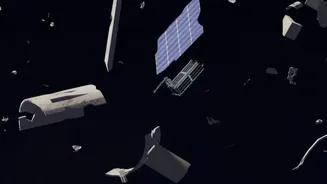
For decades, humanity has treated Low Earth Orbit (LEO) — the orbital space within 2,000 kilometres of the planet's surface — like an infinite resource. Every rocket launch and satellite deployment has left something behind, from entire defunct satellites
and spent rocket stages to tiny flecks of paint and metal fragments. The U.S. Department of Defense tracks more than 27,000 pieces of debris larger than a softball. Beyond that, estimates suggest there are hundreds of thousands of smaller, untrackable objects, each travelling at speeds up to 28,000 kilometres per hour. At that velocity, even a small object can strike a functioning satellite or spacecraft with catastrophic force, creating even more debris. Scientists have long warned of a theoretical chain reaction called the Kessler Syndrome, where the density of debris becomes so high that collisions cascade, rendering LEO unusable for generations. This isn't just a problem for astronauts; it's a threat to the global economy, which relies on satellites for everything from GPS navigation and financial transactions to weather forecasting.
The Brute-Force Approach: Harpoons
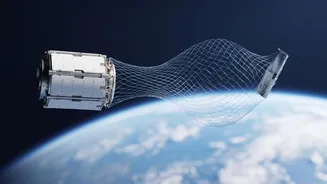
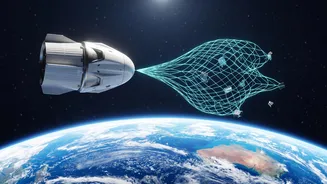
When you need to grab something from a distance, a harpoon is a classic tool. In space, the principle is the same, just far more technologically advanced. Several space agencies and private companies have developed and tested physical harpoons designed to capture large, unruly pieces of debris. In a landmark 2019 demonstration, the RemoveDEBRIS mission successfully fired a harpoon at 20 metres per second, impaling a target panel extended from the satellite. The concept is straightforward: a 'chaser' spacecraft would rendezvous with a target, like a dead satellite, fire a tethered harpoon to secure it, and then use its own thrusters to drag the junk into a lower orbit. From there, the object would enter Earth's atmosphere and burn up harmlessly. This method is effective for large, single targets and is relatively insensitive to the target's tumbling motion, which can make other capture methods like nets or robotic arms more complex.
A Contactless Nudge With Lasers
While the headline pairs lasers with harpoons, the real laser-based solutions are entirely contactless. Instead of a physical impact, these systems use the power of light to gently nudge debris off its path. The technique, known as laser ablation, involves aiming a powerful, focused laser beam at a piece of space junk. The intense energy vaporises a tiny amount of the object's surface, creating a small jet of plasma. This plasma plume acts like a miniature rocket engine, generating a small amount of thrust that alters the debris's velocity and changes its orbit. The push is gentle, but over time, repeated zaps from a ground-based or space-based laser network can be enough to push an object into an orbit where it will safely re-enter and disintegrate in the atmosphere. This approach holds promise for tackling smaller debris that is too numerous and difficult to capture with physical methods like harpoons or nets.
The Gentle Grip of Magnetic Traps
Perhaps the most futuristic solution involves manipulating debris without ever touching it. Many satellites and rocket bodies are made of conductive but non-magnetic materials like aluminum, rendering simple magnets useless. Researchers, however, have pioneered a technique using rotating electromagnets to generate a changing magnetic field near the target object. This field induces electrical whirlwinds, called eddy currents, within the debris itself. These currents temporarily turn the junk into an electromagnet, allowing the chaser spacecraft to exert forces and torques to gently slow its tumble, stabilize its rotation, and then guide it to a new position. This contactless manipulation is a game-changer for dealing with fragile objects or satellites that are spinning uncontrollably, making it safer to approach and de-orbit them. Other magnetic concepts include electrodynamic tethers, which create drag against Earth's magnetic field to slow debris down.
The Cleanup Crew Is Assembling
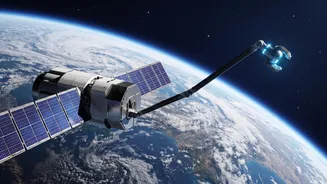
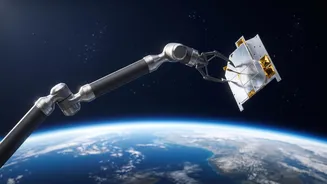
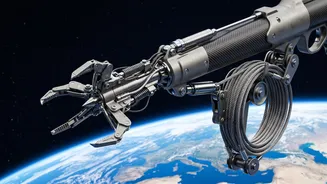
These aformentioned technologies are moving rapidly from theory to reality, with a new commercial market for orbital services emerging. Swiss startup ClearSpace, commissioned by the European Space Agency (ESA), is preparing for the world's first active debris removal mission, ClearSpace-1, slated for launch in 2028. Its spacecraft will use a set of four robotic arms to 'hug' a defunct ESA satellite and guide it to a fiery atmospheric re-entry. Another major player, the Japanese company Astroscale, has already demonstrated key technologies for magnetic docking and is developing services to remove multiple debris objects per mission. Backed by government initiatives like the U.S. ORBITS Act and funding from NASA and ESA, these companies are not just performing experiments; they are building the foundation for a sustainable space economy.