


A Groundbreaking Glimpse
Scientists have announced the best evidence to date for a substantial atmosphere around a rocky exoplanet named 55 Cancri e. Located 41 light-years away, this isn't just any atmosphere—analysis suggests it contains gases like carbon monoxide or carbon dioxide,
and crucially, water vapour. While JWST has detected atmospheres on gas giants before, finding one blanketing a solid, rocky world is a huge step forward. It proves that planets similar in composition to our own can retain a significant gaseous envelope, a critical ingredient in the recipe for potential habitability.
Welcome to a Hellish World
Before we imagine oceans and forests, it’s important to understand that 55 Cancri e is no paradise. It’s a ‘super-Earth’ nearly twice the diameter of our planet, orbiting its star at such an extreme proximity that a full year lasts less than 18 hours. This tight embrace heats its surface to over 1,700 degrees Celsius, hot enough to melt rock. The planet is likely a scorching lava world, covered in a global ocean of molten magma. The atmosphere it possesses is not a primordial one from its birth but is believed to be a 'secondary' atmosphere, continuously replenished by gases bubbling out from the boiling rock below.
What Are 'Super-Earths'?
The term 'super-Earth' might sound like a bigger, better version of our planet, but it’s a simple classification based on size and mass. These are exoplanets larger and more massive than Earth but smaller than our solar system’s ice giants, like Neptune and Uranus. Interestingly, super-Earths are one of the most common types of planets found in our galaxy, yet our own solar system doesn't have one. This makes them a major focus for astronomers. They come in many varieties—from the hot lava worlds like 55 Cancri e to potentially frozen ice planets—and studying them helps us understand the vast diversity of planetary formation across the cosmos.
How Webb Peered Into an Alien Sky
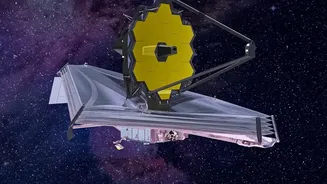
Detecting an atmosphere 41 light-years away is an incredible feat of engineering. Astronomers used JWST’s powerful infrared instruments to perform a technique called secondary eclipse photometry. They waited for 55 Cancri e to pass behind its star. Just before it disappeared, they measured the total light from the star and planet combined. When the planet was hidden, they measured the light from the star alone. The difference between these two readings revealed the light being emitted from the planet's dayside. By breaking this light down into a spectrum, scientists could identify the chemical fingerprints of the gases present, confirming the existence of its atmosphere.
A Milestone for the Search for Life
So, if 55 Cancri e is an uninhabitable ball of lava, why is this discovery so exciting? The significance lies not in the planet itself, but in what it represents. For years, scientists theorized that the intense radiation from a nearby star would blast away the atmosphere of any closely orbiting rocky planet. The discovery on 55 Cancri e challenges that idea, proving that rocky worlds can create and sustain atmospheres even under the most extreme conditions. This vastly broadens the potential number of planets that could be considered for further study. It suggests that other, more temperate rocky planets in more favourable orbits might also have atmospheres—and where there's an atmosphere and water, the questions about life can truly begin.