




A Cosmic Nursery in a Nearby Galaxy
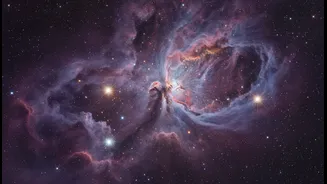
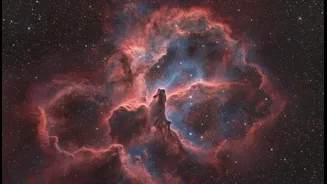
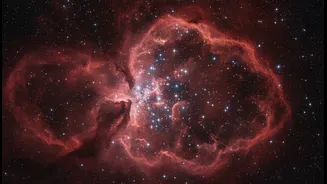
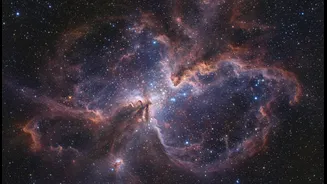
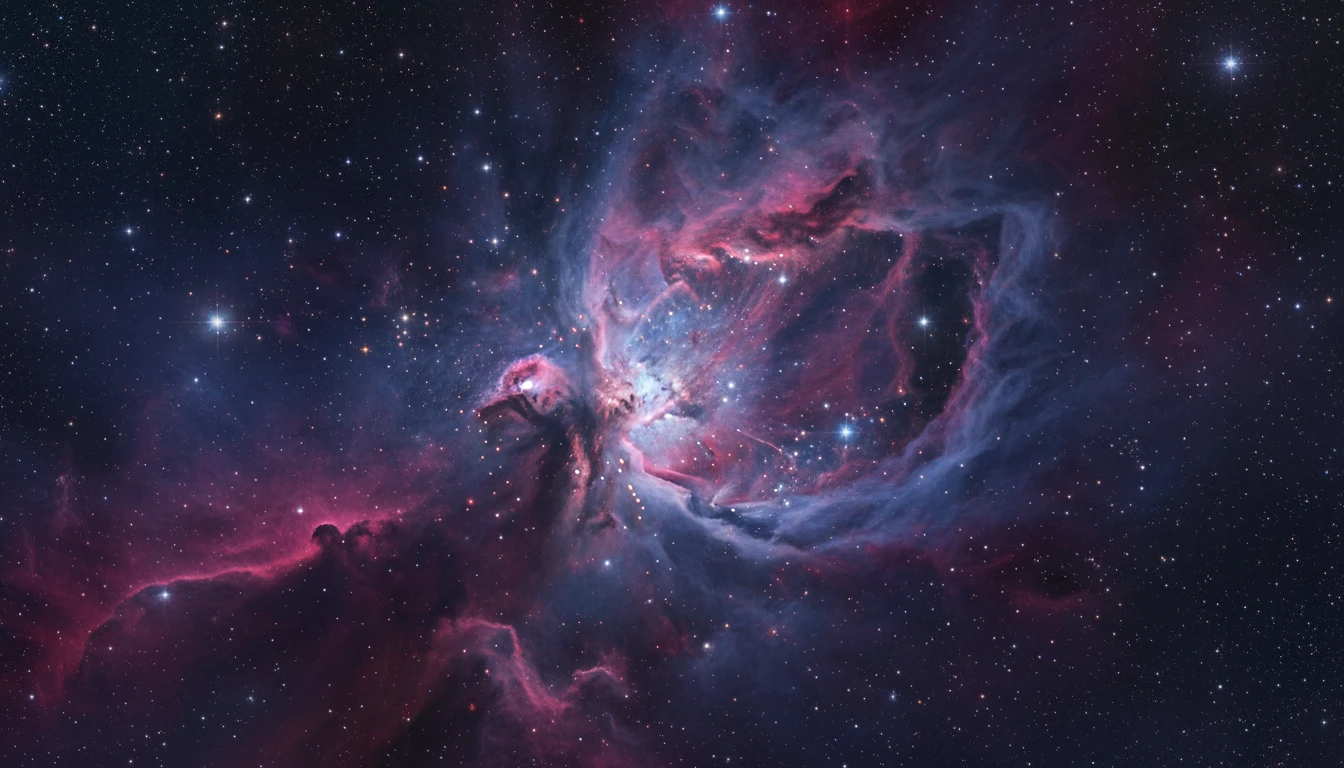
The object often nicknamed the Crimson Nebula is a vibrant region of space officially known as NGC 2074. It's located about 170,000 light-years away in the Large Magellanic Cloud, a small satellite galaxy that orbits our own Milky Way. NGC 2074 is part
of the larger Tarantula Nebula, one of the most active and prolific star-forming regions in our cosmic neighbourhood. Its distinct crimson glow, captured in breathtaking detail by the Hubble Space Telescope, comes from energised hydrogen gas—a telltale sign of intense stellar birth. Think of it as a bustling city for newborn stars, providing astronomers with a relatively unobstructed view into the chaotic and beautiful process of cosmic creation.
The Art of Star Birth
At its heart, the Crimson Nebula is a stellar nursery in full swing. The process begins within vast, cold, dark molecular clouds. Gravity, the universe’s master sculptor, patiently pulls wisps of gas and dust together. Over millions of years, these clumps grow denser and hotter, forming protostars—the embryonic stage of a star. In a region known as LH 95 within this nebula, astronomers have identified approximately 2,500 of these pre-main-sequence stars. These objects are still gathering mass from surrounding discs of material, contracting under their own weight, and are on the verge of igniting nuclear fusion in their cores, the step that will officially make them full-fledged stars.
Young Stars Reshaping Their World
Once a new star is born, it doesn't remain quiet. The most massive young stars in NGC 2074, some with at least three times the mass of our Sun, unleash ferocious stellar winds and torrents of ultraviolet radiation. This outflow of energy is what heats the surrounding hydrogen gas, causing it to glow in that characteristic crimson hue. This process, known as stellar feedback, is a powerful force. It carves out dramatic ridges, valleys, and pillars in the nebula, like the remarkable seahorse-shaped pillar of dust that is roughly 20 light-years long. While this radiation erodes the cloud, it can also compress nearby gas, potentially triggering the next wave of star formation in a cycle of cosmic renewal.
A Glimpse into Our Own Past
Studying a place like the Crimson Nebula is like looking through a time machine. The processes unfolding within it are the very same ones that led to the birth of our own Sun and solar system about 4.6 billion years ago. By observing the interplay of gas, dust, gravity, and radiation in this distant stellar factory, scientists can refine their models of star and planet formation. The region contains multiple generations of stars living side-by-side, which provides invaluable clues about how star formation unfolds over extended periods. It is a giant cosmic laboratory that helps us piece together the story of our own origins, connecting our existence on a small rocky planet to the fiery, creative forces at play across the universe.