



A Legacy of Discovery
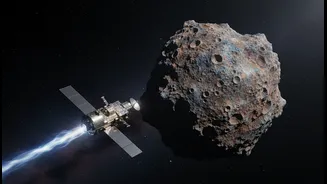
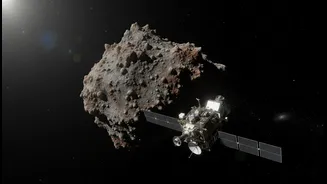
To appreciate the excitement around this month's flyby, it’s important to remember what Hayabusa2 has already accomplished. In December 2020, the Japan Aerospace Exploration Agency (JAXA) mission successfully returned about 5.4 grams of pristine material
from the carbonaceous asteroid Ryugu to Earth. These samples, collected during daring touchdowns in 2019, contained organic molecules and water, offering unprecedented clues about the building blocks of life and the formation of our solar system some 4.6 billion years ago. Having completed its primary mission in spectacular fashion, Hayabusa2 still had fuel and functioning instruments. JAXA approved an ambitious extended mission, dubbed Hayabusa2# (pronounced 'sharp'), sending the probe on a new, decade-long journey. This new phase includes multiple targets, transforming the sample-return hero into a long-haul explorer.
Meet the New Target: Asteroid Torifune
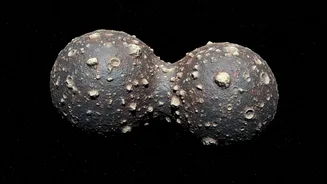
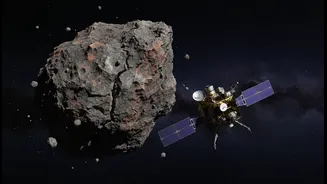
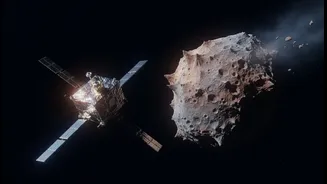
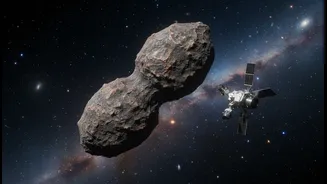
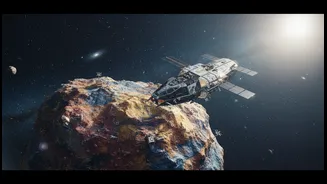
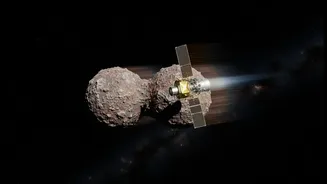
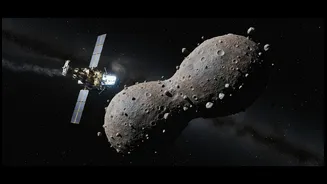
The first major objective of this extended mission is a flyby of a near-Earth asteroid officially known as (98943) Torifune, also designated 2001 CC21. The name Torifune was selected through a public contest in Japan and refers to a god and a ship from Japanese mythology known for safe, high-speed travel. On July 5, 2026, Hayabusa2 sped past this enigmatic space rock at a blistering relative velocity of about 5.25 kilometres per second. Images from the flyby revealed Torifune is an elongated, two-lobed object, often called a 'contact binary'—essentially two asteroids stuck together, resembling a snowman. Unlike the carbon-rich Ryugu, initial observations suggest Torifune is a silicate-rich S-type asteroid, giving scientists a chance to study a different kind of primordial object.
A High-Stakes Technical Challenge
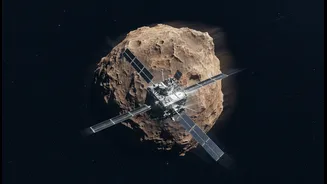
This flyby is a huge engineering test. Hayabusa2 was designed for slow, careful rendezvous manoeuvres—hovering near an asteroid for months. It was never built for a high-speed encounter where the target would be gone in minutes. The entire close-approach phase was over in a flash, demanding newly developed autonomous navigation software to lock onto, track, and image the fast-moving asteroid without real-time human control. JAXA's engineers saw this as a critical opportunity. The ability to autonomously intercept and study an unknown object at high speed is a vital technology for planetary defence. If a hazardous asteroid were discovered on a collision course with Earth with little warning, a rapid reconnaissance mission like this would be humanity's first line of response.
Why This Matters for Planetary Defence
Studying near-Earth objects (NEOs) isn't just for understanding our solar system's past; it's crucial for protecting our future. While the odds of a major impact are low, the consequences could be catastrophic. Events like the 2013 airburst over Chelyabinsk, Russia, where a 20-meter asteroid injured over 1,600 people, serve as a stark reminder of the threat even smaller objects pose. Missions like Hayabusa2's flyby provide essential data on the physical nature of these asteroids—their composition, density, and whether they are solid rocks or loose collections of rubble. This information is critical for developing effective deflection strategies, such as kinetic impactors like NASA's DART mission, which successfully altered an asteroid's trajectory in 2022. The Torifune encounter is a real-world test of our ability to find and characterise a potential threat quickly.
The Long Road Ahead
Even after this high-speed flyby, Hayabusa2's work is far from over. The spacecraft will now use gravity assists from Earth in 2027 and 2028 to set its course for its final, and perhaps most fascinating, target. In July 2031, it is scheduled to rendezvous with 1998 KY26, an extremely small and rapidly rotating asteroid only about 11 meters in diameter. This will be the smallest asteroid ever visited by a spacecraft. Exploring such a tiny, fast-spinning world will push the boundaries of space exploration once again. Each step of this extended mission builds a library of knowledge that not only helps us piece together our cosmic history but also prepares us to protect our home planet.