


A Sweet Discovery in the Stars
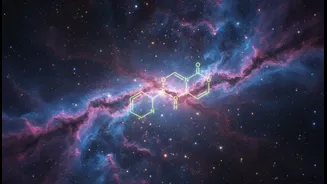
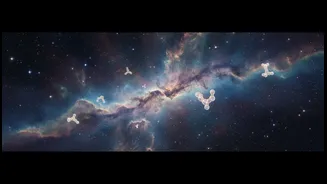
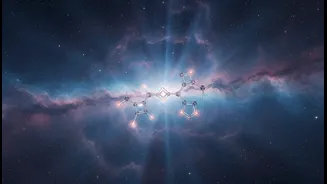
In a major breakthrough, an international team of astronomers has detected a true sugar molecule, erythrulose, in a vast cloud of gas and dust near the center of our galaxy. This marks the first-ever direct detection of a sugar in the interstellar medium—the
cold, diffuse material that exists between stars. Previous discoveries had found sugars like ribose in meteorites that had already fallen to Earth, but finding one floating in deep space is a significant leap. The discovery was made using powerful radio telescopes in Spain, which scanned a molecular cloud named G+0.693−0.027, located some 26,745 light-years away. The team, led by Izaskun Jiménez-Serra of the Spanish National Research Council, identified the unique radio frequency 'fingerprint' of erythrulose, confirming its presence among the cocktail of cosmic chemicals.
What is Erythrulose?
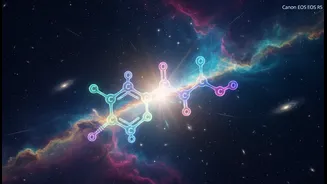
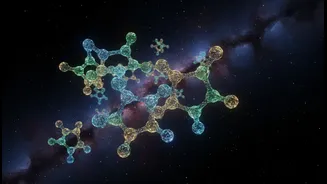
Erythrulose is a four-carbon sugar (a tetrose) that, on Earth, is naturally found in things like red raspberries. While you might also know it as an ingredient in sunless tanning lotions, its cosmic significance is far more profound. In the grand scheme of biology, sugars are fundamental. They are not only a source of energy but also form the structural backbone of RNA and DNA, the molecules that carry life's genetic instructions. Erythrulose is considered a prebiotic molecule, meaning it's a chemical precursor that could lead to the formation of more complex molecules essential for life. Specifically, in watery environments, it can transform into molecules that are considered evolutionary predecessors to RNA. This makes its formation in space incredibly exciting.
Challenging Theories of Cosmic Creation
The discovery is more than just a new entry in the catalog of interstellar molecules; it challenges existing theories about how complex molecules form in space. The prevailing view was that molecules grow incrementally, adding one carbon atom at a time. However, the team found that erythrulose was at least eight times more abundant than any simpler three-carbon sugars in the same cloud, which were not detected at all. This suggests a different chemical pathway might be at play. Scientists now believe erythrulose forms efficiently on the icy surfaces of tiny dust grains from the combination of simpler, two-carbon molecules that are abundant in space. This shows that nature has a way of building complex structures even in the freezing, near-vacuum of a molecular cloud.
From Interstellar Cloud to Early Earth
One of the central puzzles in origin-of-life research is the 'sugar problem.' While sugars are essential, laboratory experiments simulating conditions on early Earth have struggled to produce them in sufficient quantities to kickstart biology. This discovery bolsters a compelling alternative: the ingredients for life weren't made on Earth, but delivered here. Scientists speculate that vast quantities of erythrulose and other complex molecules formed in space could have been delivered to a young Earth via comets and asteroids during the 'Late Heavy Bombardment' period over 4 billion years ago. This cosmic delivery service could have seeded our planet with the raw materials needed for life to emerge, bypassing the difficult chemistry on the ground.
A New Frontier in Astrobiology
The detection of interstellar erythrulose is a game-changer for astrobiology. It confirms that the universe is capable of creating molecules of significant prebiotic relevance far from any planet. It shifts the focus from merely searching for simple organic molecules to hunting for specific, complex and even chiral molecules—those with a 'handedness,' a key feature of biological molecules. Finding erythrulose gives scientists confidence that other, even more critical, sugars like ribose (the 'R' in RNA) could also be lurking in these stellar nurseries. It suggests the chemical potential for life is not a rare fluke, but could be a common feature throughout the galaxy, just waiting for the right planetary conditions to unfold.