






India is making a bold, multi-billion-dollar entry into the global semiconductor race. With major projects underway, the ambition is clear. But why does it take years and billions of dollars to produce a single computer chip from a new factory?
The Scale of Ambition
India has
earmarked approximately $23 billion to cultivate a domestic semiconductor industry, a strategic push to create skilled jobs and reduce reliance on complex global supply chains. This initiative has already seen about a dozen projects approved, including assembly and testing facilities. The cornerstones of this push are two major projects in Gujarat: a $2.75 billion assembly and test facility by US-based Micron in Sanand, and an $11 billion wafer fabrication plant, or 'fab', in Dholera by Tata Electronics in partnership with Taiwan's PSMC. While the Micron plant, which assembles and tests chips, has already started commercial production, the Tata fab, which performs the far more complex task of manufacturing chips from raw silicon wafers, is targeting operations to begin in 2028.
A Blueprint Measured in Billions
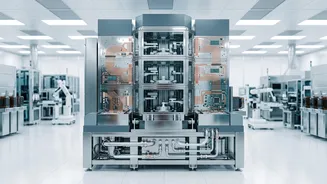
The price tag for a modern semiconductor fab is staggering. A single leading-edge factory can cost over $10 billion. These costs are driven by the need for thousands of highly specialized, multi-million dollar tools. For instance, the photolithography machines that print microscopic circuit patterns onto silicon wafers are among the most complex instruments ever built, costing over $100 million each. The sheer scale of construction is also immense, often requiring thousands of workers, millions of hours, and tonnes of structural steel equivalent to multiple landmarks. Beyond the building itself, a fab needs a massive and highly reliable utility infrastructure, including systems for ultra-pure water, process cooling, and uninterrupted power, as even a minor fluctuation can ruin entire batches of chips.
The Cleanroom: A War Against Dust
At the heart of every fab is the cleanroom, an environment engineered to be almost entirely free of contaminants. Manufacturing at the nanoscale means that even a single speck of dust, invisible to the naked eye, can destroy a chip. These facilities are often rated at ISO Class 1, allowing for no more than one tiny particle per cubic foot of air. To maintain this purity, workers must wear head-to-toe 'bunny suits', and the air is constantly filtered and maintained at a precise temperature and humidity. Building a cleanroom, which can be larger than several football fields, is a meticulous process that contributes significantly to the construction timeline and cost.
An Ecosystem, Not Just a Factory
A chip fab cannot exist in isolation. It requires a surrounding ecosystem of hundreds of partners supplying specialized gases, chemicals, and materials. For its Dholera plant, Tata Electronics has already brought over 450 ecosystem partners on board. A skilled workforce is another critical component. These facilities require highly trained engineers and technicians to operate and maintain the complex machinery. This shortage of skilled workers is a global challenge in the semiconductor industry. Recognizing this, India's push includes initiatives for local skill development and partnerships with universities to build a talent pipeline. Furthermore, the site itself must have access to vast amounts of water and reliable power, making site selection a crucial first step.
The Long Road to the First Chip
From groundbreaking to fullscale production, the timeline can stretch from three to five years. The initial phase involves massive construction of the building and its complex support systems. This is followed by the 'toolin' phase, where thousands of pieces of manufacturing equipment are delivered and painstakingly installed and calibrated, a process that can take many months. Once the equipment is running, it enters a long period of qualification and yield ramping. Engineers must finetune hundreds of complex process steps to ensure that a high percentage of the chips on each wafer are functional. Achieving a profitable yield can take years of incremental improvements and deep institutional knowledge. Even with construction reportedly on track, the TataPSMC Dholera fab is targeting trial production by late 2026, with commercial operations planned for 2028.