




The Old Story: Rocks vs. Snowballs
In the classical model of our solar system, the story was straightforward. Asteroids were the rocky, lifeless chunks of debris that mostly lived in the main asteroid belt between Mars and Jupiter. They were considered inactive because they were forged
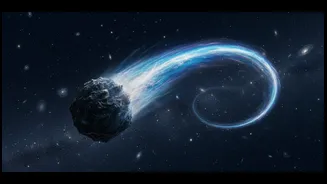
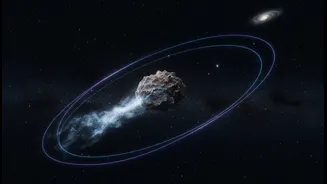
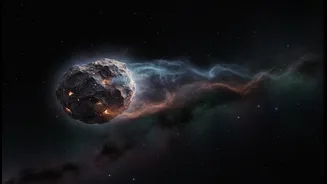
in the warmer, inner solar system where any surface ice would have long since vanished. Comets, on the other hand, were the dramatic celestial visitors from the cold, outer reaches. Composed of dust and frozen gases, they develop their signature fuzzy coma and long tail when their orbit brings them close enough to the Sun for those ices to vaporize. One was a dead rock; the other, a dirty snowball. This neat binary made sense, as it was based on both their appearance and their orbital dynamics. Scientists could classify most small bodies by simply observing whether they had a tail and calculating their Tisserand parameter, a value related to their orbit around Jupiter.
A Universe of Blurred Lines
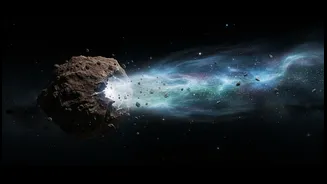
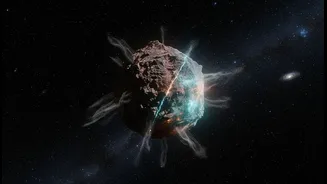
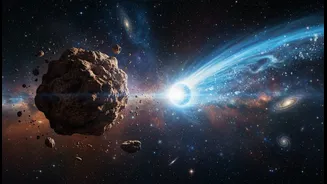
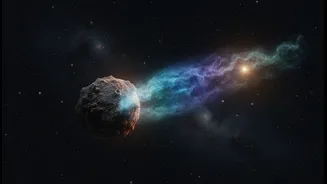
This tidy picture began to fall apart with the discovery of objects that defied easy classification. Astronomers started finding bodies in classic asteroid orbits that were exhibiting comet-like activity, such as ejecting dust or gas. These objects were dubbed “active asteroids” or “main-belt comets,” and they directly challenged the old assumptions. The dwarf planet Ceres, the largest object in the asteroid belt, was found to have plumes of water vapor shooting from its surface. More recently, the James Webb Space Telescope detected water vapor around another main-belt object, Comet Read, confirming that water ice from the early solar system can indeed be preserved in the asteroid belt. Conversely, some objects on cometary orbits appear completely inert, suggesting they are “dormant” or “extinct” comets that have lost their surface volatiles, effectively masquerading as asteroids. This has led scientists to embrace the idea of an “asteroid-comet continuum,” recognizing that these bodies aren't two distinct classes but exist on a spectrum.
The Ultimate Opportunity: Water in the Belt
The revelation that many supposedly inactive asteroids are actually water-rich has profound implications. The single greatest opportunity this presents is access to in-situ resources—specifically, water. Water is arguably the most valuable resource in space. It can be used for life support for astronauts, but more importantly, it can be split into hydrogen and oxygen, the primary components of rocket fuel. The ability to refuel spacecraft at an asteroid would revolutionize space exploration. It would dramatically cut the cost of missions, as a huge portion of a rocket’s launch mass is the fuel needed to leave Earth. Establishing a supply line from asteroids could make deep space missions, lunar bases, and eventual Mars colonization far more sustainable and affordable. Near-Earth asteroids, which are easier to reach than the Moon due to their lower gravity, are now seen as potential cosmic water depots. Studies suggest that thousands of water-rich asteroids are within our reach, containing enough water to power a burgeoning space economy.
A New Blueprint for Exploration and Defense
This more flexible view of small worlds is not just about resources; it's reshaping our entire strategy for space. Scientifically, studying these “continuum objects” offers a window into the solar system's formation and the origin of water on Earth. If asteroids in the inner solar system hold water, it strengthens the theory that they, along with comets, delivered the essential ingredients for life to our planet billions of years ago. From a business perspective, the presence of water and valuable minerals on accessible asteroids has fueled the ambitions of a new generation of space-mining companies. Though still a hypothetical industry, the long-term economic potential is staggering. Furthermore, understanding the composition of these objects is critical for planetary defense. Some researchers have suggested that in the distant future, mining potentially hazardous asteroids could be a way to shrink them, altering their orbits and neutralizing a threat long before it becomes critical.