
A Global Celestial Event
On August 12, 2026, the Moon will pass directly in front of the Sun, casting its shadow onto Earth. This alignment will create a total solar eclipse along a narrow track that crosses Greenland, western Iceland, and northern Spain. The period of total darkness,
known as totality, will last for a little over two minutes at its peak off the coast of Iceland. While India will not be able to witness this event directly as it occurs late at night locally, a vast area of the globe will experience a partial eclipse. Much of Europe, northwestern Africa, and parts of North America will see the Moon take a 'bite' out of the sun. For those in India, the event can still be followed through live broadcasts from astronomical agencies.
The Partial View: A Good Appetiser
For most viewers, this event will be a partial solar eclipse. This is what happens when the Sun, Moon, and Earth aren't perfectly aligned, or when a viewer is outside the path of the Moon's inner shadow, the umbra. During a partial eclipse, the sky might dim slightly, as if under a thin cloud, and the temperature may drop a little. It’s an interesting phenomenon, but even a 99% partial eclipse is not a miniature version of a total one. The Sun's remaining crescent, though small, is intensely bright and washes out the most spectacular features of the event. At no point during a partial eclipse is it safe to look at the sun without specialised eye protection.
The Total View: The Main Course
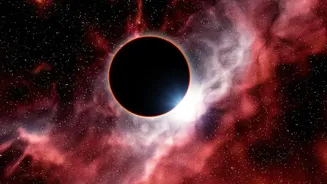
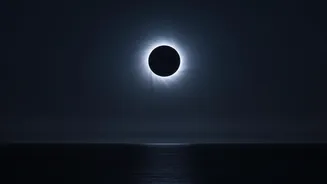
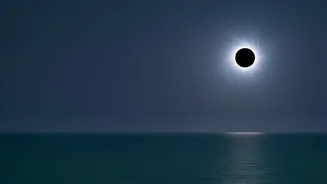
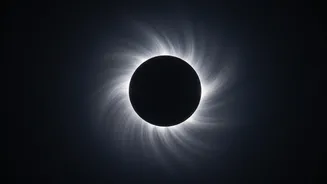
Being inside the path of totality is a completely different experience. As the Moon fully covers the Sun, a series of unique phenomena occur. The final sliver of sun creates a brilliant flash known as the 'diamond ring' effect. Then, darkness descends abruptly. The sky becomes dark enough to see bright stars and planets. But the true spectacle is the Sun's corona—its ethereal outer atmosphere—which becomes visible as a pearly white halo. This is the only time the corona can be seen with the naked eye. Those in the path of totality can, for the brief moments of the total eclipse only, safely remove their eye protection to witness this breathtaking sight.
Why Totality Changes Everything
The scientific reason for this dramatic difference lies in the sheer brightness of the Sun's main surface, the photosphere. The photosphere is millions of times brighter than the corona. Even when 99% of the Sun is covered during a partial eclipse, the remaining 1% of the photosphere is still bright enough to obscure the faint corona completely. It's an all-or-nothing event; only with 100% coverage does the Sun's hidden atmosphere reveal itself. This is why eclipse chasers travel the globe to position themselves within the narrow path of totality. The experience is often described as multi-sensory and deeply moving, a stark contrast to the more subtle partial view.
How to Watch Any Eclipse Safely
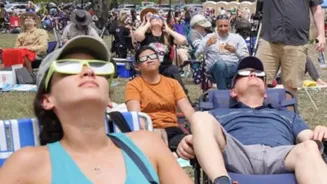
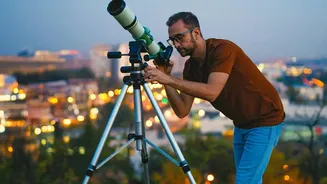
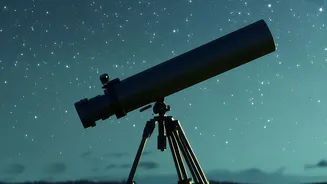
Whether partial or total, viewing a solar eclipse requires stringent safety measures. During all partial phases, you must use certified solar viewing glasses (often called 'eclipse glasses') or a handheld solar viewer. Regular sunglasses, no matter how dark, are not safe for looking at the Sun. An alternative method is projection, where you use a pinhole in a card to project an image of the Sun onto a surface. Never look at the Sun through a camera, binoculars, or a telescope without a special-purpose solar filter secured over the front of the optics. The only time it is safe to look directly at the eclipse is during the brief period of 100% totality; as soon as the Sun begins to reappear, you must put your eclipse glasses back on.