


Sailing on Sunshine
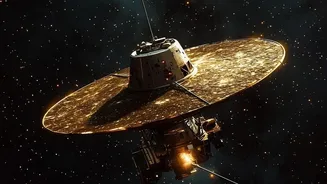
At its core, a solar sail works much like a sailboat on water, but instead of wind, it uses the subtle pressure of sunlight to move. Light is made of particles called photons which, despite having no mass, carry momentum. When these photons strike a large,
reflective sail, they transfer their momentum, giving the spacecraft a tiny, continuous push. In the frictionless vacuum of space, this constant nudge adds up, allowing the spacecraft to build tremendous speed over time without carrying any fuel at all. This is a fundamental departure from chemical rockets, which provide powerful but short bursts of thrust by burning heavy propellants.
From Concept to Cosmos
The idea of light pressure has been around for over a century, but turning it into a viable propulsion system has been a long journey. Japan's IKAROS mission in 2010 was the first to successfully demonstrate controlled solar sailing in interplanetary space. More recently, The Planetary Society's crowdfunded LightSail 2 mission, which operated from 2019 to 2022, proved that a small satellite, known as a CubeSat, could use a solar sail to change its orbit around Earth. These missions provided invaluable data, proving the concept and paving the way for more ambitious projects.
The New Generation of Sails
Recent advancements are focused on making sails larger, lighter, and more durable. A key area of innovation is in the booms—the masts that deploy and support the sail. NASA's Advanced Composite Solar Sail System (ACS3) mission, launched in 2024, is testing new composite booms made of flexible polymer and carbon fibre. These materials are significantly lighter and more stable under the extreme temperatures of space than the metallic booms used in the past. The successful deployment of ACS3's apartment-sized sail is a crucial step toward building even larger sails, potentially the size of a basketball or even a soccer field, which are necessary for deep space missions.
Sails vs. Rockets: The Trade-Offs
The primary advantage of solar sails is their unlimited propulsion source: sunlight. This gives them what rocket scientists call an infinite specific impulse, meaning they don't need to carry propellant. This drastically reduces launch mass and cost, and allows for missions that would be impossible for fuel-limited spacecraft. However, the thrust from a solar sail is very gentle. While a chemical rocket provides immense power for a fast trip to Mars, a solar sail accelerates slowly and is better suited for long-duration missions where speed can be built up over months or years. For applications like hauling resources from asteroids or sending probes to the outer solar system, studies suggest solar sails could be more cost-effective than chemical rockets.
Future Horizons and India's Role
The technology is poised to enable a new class of missions. Solar sails could be used to create stable observation platforms for monitoring solar storms, providing earlier warnings for space weather that can disrupt satellites and power grids on Earth. They are also considered one of the few viable technologies for eventual interstellar travel. While there is no official ISRO solar sail mission currently announced, the global advancements in low-cost space exploration are highly relevant to India's ambitious space program. As the nation expands its interplanetary footprint with missions to Venus and beyond, the propellant-free nature of solar sails could offer a strategic advantage for future scientific and commercial ventures in the cosmos.