



A Day Longer Than a Year
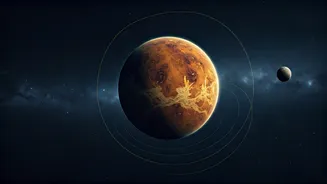
Let’s get the mind-bending numbers out of the way first. A ‘year’ on any planet is the time it takes to complete one orbit around the Sun. For Venus, this journey takes about 225 Earth days. Simple enough. But a ‘day’ is more complicated. A planetary
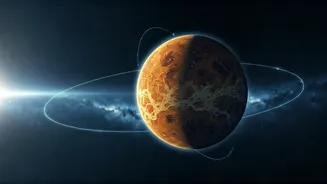
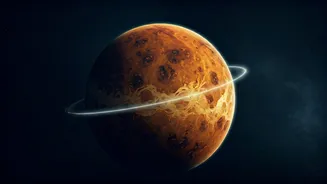
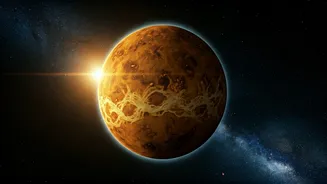
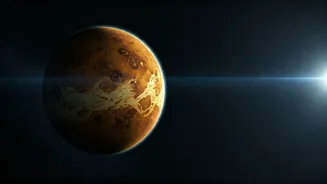
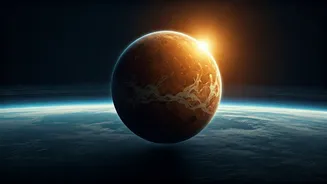
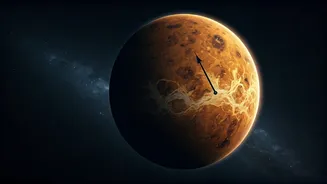
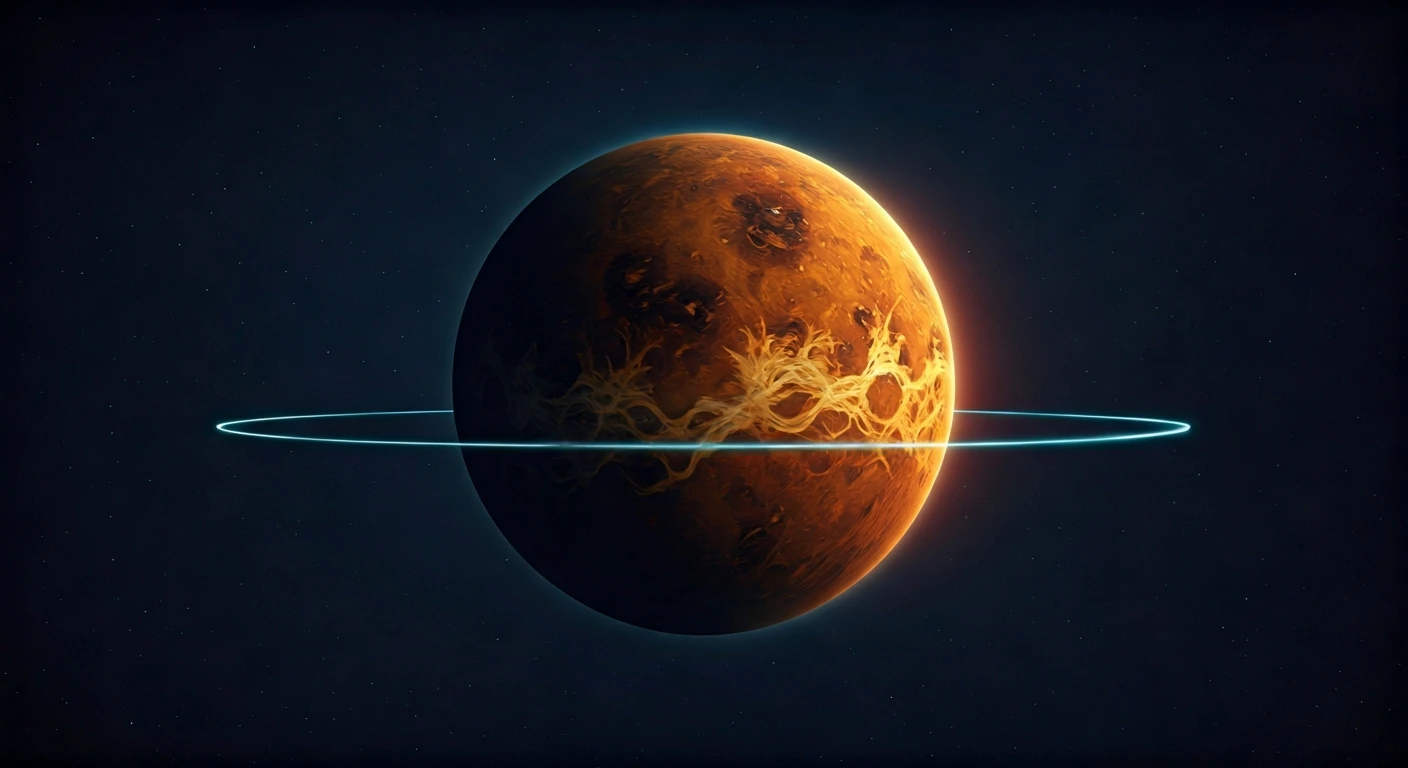
day is the time it takes to complete one full rotation on its axis. On Earth, that’s 24 hours. On Venus, one rotation takes a staggering 243 Earth days. That’s right: a single day on Venus (243 Earth days) is longer than a Venusian year (225 Earth days). If you could stand on its surface, the planet beneath your feet would be spinning so slowly that it completes its trip around the Sun before it finishes a single turn. This makes Venus a true outlier in our solar system, a place where our fundamental concepts of time get completely scrambled.
Spinning the Wrong Way
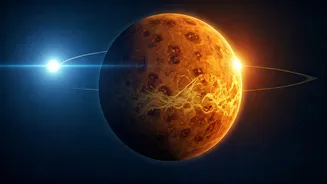
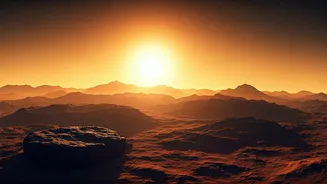
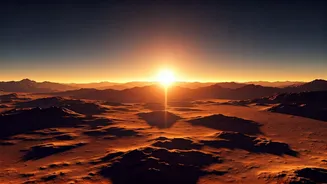
As if a day longer than a year wasn't strange enough, Venus also spins backwards. Nearly every planet in our solar system, including Earth, rotates on its axis in the same direction it orbits the Sun (counter-clockwise when viewed from above the Sun's north pole). This is called prograde rotation. Venus, however, spins clockwise in what is known as retrograde rotation. What would this look like? On Earth, the Sun rises in the east and sets in the west. On Venus, it rises in the west and sets in the east. But you’d have to be patient. Because the planet’s rotation is so slow, and it’s also moving in its orbit, the time from one sunrise to the next (a solar day) is about 117 Earth days. That means you’d get to see a sunrise only twice a year, with each period of daylight lasting for nearly two Earth months.
The Mystery of the Slow Spin
So, why is Venus so weird? Scientists don’t have a single, definitive answer, but there are two leading theories. The first involves a catastrophic collision. Early in the solar system's history, a massive asteroid or planetesimal may have slammed into Venus, altering its spin and tilting it upside down, effectively making it rotate in reverse. Such cosmic collisions were common in the early, chaotic days of planetary formation. The second, more recent theory suggests a more gradual process. Venus has an incredibly thick, heavy atmosphere—more than 90 times the pressure of Earth's. This dense atmosphere, whipping around the planet much faster than the planet itself spins, could be acting like a brake. Over billions of years, powerful atmospheric tides and friction between the atmosphere and the solid planet could have slowed Venus’s rotation to its current crawl and even reversed it.
Earth's Uninhabitable Twin
The bizarre rotation is just one feature that makes Venus a fascinating but terrifying world. It’s often called Earth’s “sister planet” because of its similar size and mass, but it’s more like an evil twin. Its thick atmosphere is almost entirely carbon dioxide, creating a runaway greenhouse effect that makes it the hottest planet in the solar system. Surface temperatures average around 465 degrees Celsius—hot enough to melt lead. The atmospheric pressure at the surface is equivalent to being 1 kilometre deep in Earth’s oceans, a force that would crush a submarine not built for such depths. To top it all off, the clouds aren't made of water but of corrosive sulphuric acid. It’s a vision of a paradise lost, a world that may have once been more like Earth but took a drastically different evolutionary path.