





2001: A Space Odyssey (1968)
To talk about visual spectacle in space movies is to start with Stanley Kubrick’s masterpiece. Decades after its release, '2001' remains a benchmark for its startlingly realistic and artistically ambitious vision. Kubrick obsessed over every detail, aiming
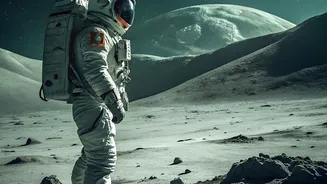
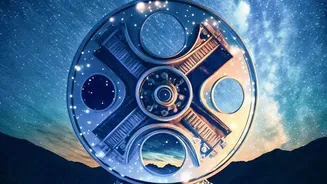
to create special effects that were completely convincing. He did this by pioneering techniques like front projection for the film's prehistoric opening and using a massive, rotating centrifuge set to simulate artificial gravity—an effect that still stuns audiences today. The 'Star Gate' sequence, a psychedelic journey of light and color created with a custom 'slit-scan' machine, is a purely cinematic experience that defies easy explanation. '2001' is not just a film; it is a meticulously designed visual symphony, from its sterile, geometric sets to its majestic, silent spacecraft waltzing to classical music, proving that visual lore could be both intelligent and awe-inspiring.
Gravity (2013)
If '2001' was a stately ballet, Alfonso Cuarón’s 'Gravity' is a heart-pounding panic attack in zero-g. This film is arguably one of the most immersive cinematic experiences ever created. The movie's visual effects, led by Framestore, are central to the story itself, conveying the terror and isolation of being stranded in orbit. Cuarón’s signature long, unbroken takes are on full display, choreographed with a dizzying blend of live-action and seamless digital effects that blur the line between what is real and what is rendered. The film's opening shot is legendary, a minutes-long continuous sequence that establishes the characters, the environment, and the stakes before chaos erupts. The filmmakers essentially built a digital production, where computer-generated imagery was not just an addition but the foundation of the entire film. Seen on an IMAX screen, 'Gravity' doesn't just show you space; it throws you into it, making the audience feel every terrifying spin and desperate gasp for air.
Interstellar (2014)
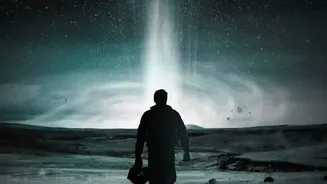
Christopher Nolan is a director famously committed to in-camera, practical effects, and 'Interstellar' is his grandest love letter to the tangible. While the film is celebrated for its mind-bending plot and emotional core, its visual power comes from its grounding in reality. Nolan built full-scale spaceship sets, launched high-altitude balloons to capture footage above the stratosphere, and, most famously, collaborated with theoretical physicist Kip Thorne to create a scientifically accurate visualization of a black hole. This resulted in imagery so groundbreaking it led to new scientific papers. The film’s visual language is one of contrasts: the dusty, dying Earth versus the clean, functional lines of the Endurance spacecraft; the terrifying scale of a planet-sized wave versus the intimate confines of a cockpit. By prioritizing physical sets and location shooting, Nolan created a tactile universe that feels less like a fantasy and more like a future we could actually touch, making the cosmic journey feel profoundly real.
Blade Runner 2049 (2017)
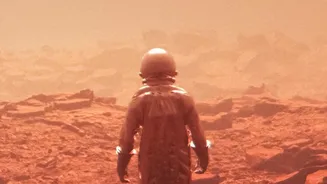
While not strictly a space exploration film, its off-world colonies and futuristic cityscapes earn it a spot on any list of visual spectacles. Director Denis Villeneuve and legendary cinematographer Roger Deakins crafted one of the most beautiful science-fiction films ever made. Every frame is a painting. The film expands on the original's noir aesthetic, but gives it a new, desolate beauty. Where the 1982 film was perpetually dark and rainy, '2049' introduces vast, empty landscapes bathed in an orange, radioactive haze, and interiors defined by stark, geometric lighting and bold color palettes. Deakins famously used color to signify emotion and information—yellow for enlightenment, cold blues for isolation. The visual language is clean and utilitarian, with technology that feels both futuristic and worn-down. It is a slower, more meditative film that uses its immense scale and breathtaking visuals to explore themes of isolation and what it means to be human in a synthetic world.
Dune (2021 & 2024)
Denis Villeneuve returns to the list with his adaptation of Frank Herbert’s famously 'unfilmable' novel. 'Dune' is a masterclass in world-building through scale and texture. Villeneuve and cinematographer Greig Fraser made the colossal feel real, a concept Fraser termed 'brutalism.' The ships are not sleek and graceful; they are massive, imposing structures of metal that roar through the atmosphere. The desert planet of Arrakis is not just a backdrop; it is a living, breathing character, its immense heat and endless sands conveyed through every shot. The visual design is incredibly detailed, establishing distinct looks for different factions and planets—from the lush green of Caladan to the industrial gloom of Giedi Prime. By taking its time and immersing the audience in the environment, 'Dune' doesn’t just tell you about its world; it makes you feel the sand in your eyes and the ground tremble as a sandworm approaches. It is a sensory epic made for the biggest screen possible.