




Why Your Upper Back Aches
Before diving into the exercises, it helps to understand the cause of the discomfort. When you sit for prolonged periods, especially while looking at a screen, your posture tends to suffer. Your head drifts forward, your shoulders round, and your upper
back (the thoracic spine) remains in a flexed, or bent, position for hours. This sustained posture causes the muscles across your chest to tighten while the muscles in your upper back become overstretched and fatigued, leading to that all-too-common stiffness and burning sensation. The key is to break this pattern with frequent, targeted movements that do the opposite: open the chest, rotate the spine, and activate the underused muscles between your shoulder blades.
1. Seated Thoracic Extension
This movement directly counters the forward slump of desk work by encouraging your upper back to arch in the opposite direction. It helps restore mobility to the thoracic spine. To perform it, sit toward the front of your chair with your feet flat on the floor. Place your hands behind your head to support your neck. Gently lean back, allowing your upper back to arch over the back of your chair, and look toward the ceiling. Hold for a few seconds, feeling a stretch across your chest and upper back. Return to the starting position and repeat 5 to 8 times.
2. Seated Spinal Rotation
Rotation is a crucial movement that your thoracic spine often misses out on during the workday. Adding it back in can ease stiffness significantly. While sitting tall in your chair, cross your arms over your chest, placing your hands on your shoulders. Keeping your hips and legs stationary, slowly rotate your upper body to the right as far as is comfortable. Hold for a moment before returning to the centre, then repeat on the left side. Aim for 8 to 10 smooth rotations on each side.
3. Shoulder Blade Squeezes
Also known as scapular retraction, this simple exercise activates the weakened muscles between your shoulder blades (the rhomboids and middle trapezius). Sit or stand with your back straight and your arms resting at your sides. Without shrugging your shoulders up toward your ears, gently squeeze your shoulder blades together as if you're trying to hold a pencil between them. Hold the squeeze for 3 to 5 seconds, then relax. Repeat 10 to 15 times to wake up these important postural muscles.
4. Chin Tucks
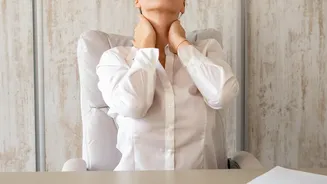
Forward head posture is a major contributor to neck and upper back tension. Chin tucks help correct this by strengthening the deep muscles in the front of your neck. Sit or stand tall, looking straight ahead. Gently draw your head straight back, creating a 'double chin' without tilting your head up or down. You should feel a stretch at the base of your skull and an engagement of the muscles under your chin. Hold for 5 seconds and release. Perform 10 repetitions to reset your head position.
5. Overhead Arm Reach
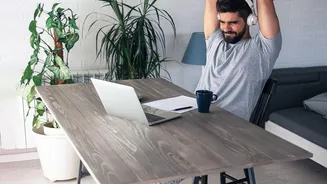
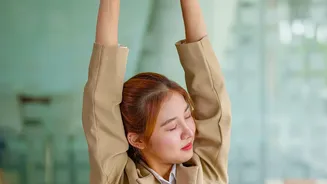
This stretch targets the latissimus dorsi and shoulder muscles, which can become tight from sitting. While seated, extend your right arm straight up toward the ceiling. Gently bend your torso to the left, reaching your right arm over your head until you feel a stretch along the right side of your body. Hold for 15 to 20 seconds, breathing deeply. Return to the starting position and repeat on the other side.
6. Doorway Chest Stretch
This is one of the most effective ways to open up a tight chest. Stand in an open doorway. Place your forearms on the doorframe on either side, with your elbows bent at roughly a 90-degree angle, just below shoulder height. Step forward with one foot until you feel a gentle but effective stretch across the front of your chest and shoulders. Hold this position for 20 to 30 seconds, making sure not to arch your lower back. Repeat 2 to 3 times.
7. Upper Trapezius Stretch
This stretch targets the upper trapezius muscle, which runs from your neck to your shoulder and often carries a lot of tension. While sitting in your chair, gently tilt your right ear toward your right shoulder. You can use your right hand to apply very gentle pressure to the side of your head for a deeper stretch. To increase the stretch, you can sit on your left hand or hold onto the side of the chair. Hold for 20-30 seconds, then slowly release and repeat on the other side.