




The Twin Dangers: Wear and Terrain
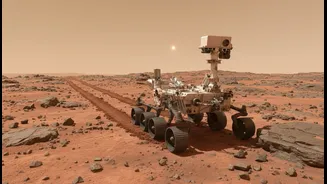
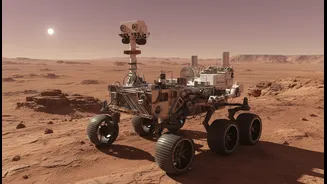
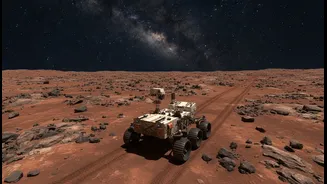
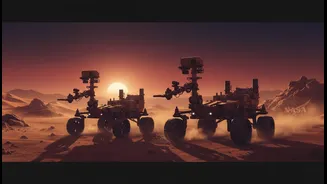
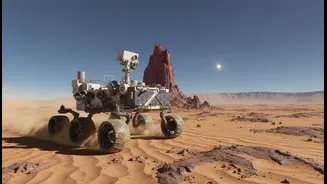
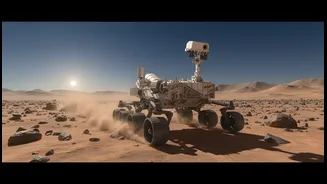
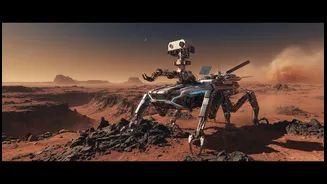
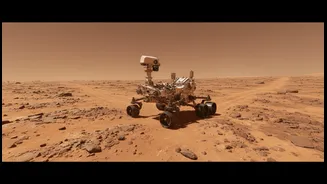
For any mobile robot, but especially for planetary rovers, two fundamental risks dominate mission planning: wear and route. Wear is the slow, inevitable degradation of mechanical parts. On Mars, this is most famously seen in the wheels of rovers like
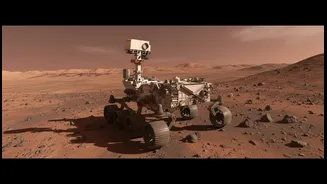
Curiosity. Made of aluminum just 0.75 millimeters thick, Curiosity's wheels began accumulating punctures and cracks faster than expected after encountering sharp, wind-eroded rocks called ventifacts. Route risk involves navigating the treacherous, often poorly understood landscape. A single bad decision can lead to a rover getting stuck in deep sand, like the Spirit rover, or tipping over on a steep, unstable slope. These are not independent problems; a hazardous route accelerates wear, and worn components limit the routes a rover can safely take. The job of an engineering team is to manage this constant trade-off to maximize the scientific return over the longest possible lifespan.
Modeling and Mitigating Wear
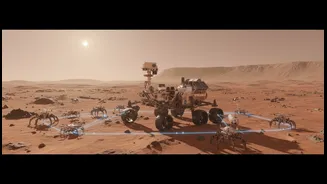
Engineers can't fix a rover's wheel on Mars, so they focus on predicting and managing damage before it happens. A key tool in this effort is the 'digital twin' — a high-fidelity virtual replica of the physical rover. First pioneered by NASA during the Apollo program, digital twins integrate real-world data from the rover with complex models to simulate how systems will behave. By running thousands of virtual scenarios, engineers can understand how different types of terrain will stress the wheels or how dust will affect moving parts. When Curiosity's wheels began to show significant damage, engineers at JPL developed a new traction-control algorithm. This software adjusts the speed of individual wheels in real-time to reduce pressure when climbing over sharp rocks, significantly slowing the rate of damage. They also learned from this experience. The Perseverance rover, which landed in 2021, was equipped with redesigned, more robust wheels made of thicker aluminum to better withstand the harsh Martian surface.
The Art and Science of Route Planning
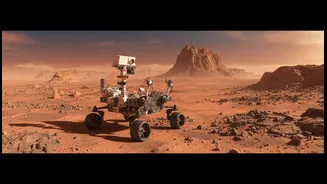
Choosing a path for a rover is a painstaking process that balances ambition with caution. Due to the significant signal delay between Earth and Mars, rovers cannot be driven with a joystick in real-time. Instead, planners spend hours scripting each drive, which the rover then executes autonomously. The process starts with orbital images, which give a bird's-eye view of the landscape but often can't reveal smaller hazards like sharp rocks or the exact steepness of a slope. As the rover gets closer, it uses its own cameras to build a more detailed 3D map of the immediate surroundings. Onboard autonomous navigation software then analyzes this map, creating a 'cost map' where safe, flat ground is assigned a low cost and dangerous slopes or sand traps are given a high cost. Pathfinding algorithms like A* then calculate the safest, most efficient route through this cost map. However, human oversight is critical. Planners must constantly weigh the scientific value of reaching a destination against the risks of the journey, sometimes opting for a long detour to avoid a dangerously appealing shortcut.
Lessons for Earth-Bound Engineers
The principles used to guide robots on Mars are directly applicable to robotics and engineering on Earth. Every robotics project requires a thorough risk assessment that identifies potential hazards, from mechanical failure to environmental factors and human error. This involves both qualitative judgment and quantitative analysis to prioritize the most severe risks. The strategies used by NASA — implementing engineering controls (like stronger wheels), administrative controls (careful route planning), and software solutions (traction control) — are the same fundamental pillars of risk management in any high-stakes field. For students and aspiring engineers, studying how rover teams handle unexpected problems provides a masterclass in creative problem-solving. When Curiosity's drill mechanism failed, engineers developed an entirely new drilling technique using the hardware they had, essentially reinventing the process from 100 million miles away. This mindset of adapting and overcoming limitations is the hallmark of great engineering.