



The Challenge of Starlight
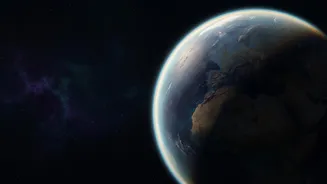
Finding and studying exoplanets—planets orbiting stars other than our Sun—is one of the great technological hurdles of modern science. These worlds are incredibly faint and almost always lost in the blinding glare of their parent stars. But scientists
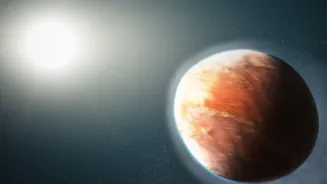
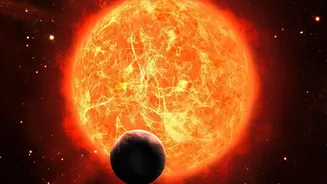
have a clever workaround. When a planet’s orbit causes it to pass directly in front of its star from our perspective, an event known as a transit, a tiny fraction of the starlight filters through the planet’s atmosphere. This provides a fleeting but valuable opportunity to learn what that atmosphere is made of.
Reading an Alien Atmosphere
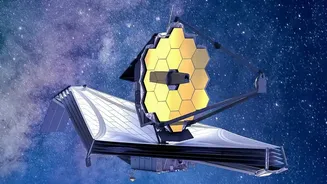
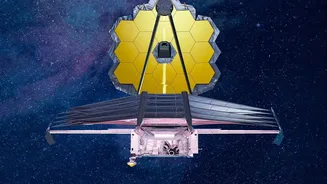
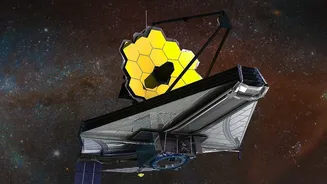
The technique is called transmission spectroscopy. Think of it like a chemical barcode. As starlight passes through an exoplanet’s atmosphere, different gas molecules absorb very specific wavelengths, or colors, of that light. When astronomers on Earth capture the remaining light with powerful instruments like the James Webb Space Telescope (JWST), they see a spectrum with dark lines where light has been absorbed. Each pattern of missing light corresponds to a specific chemical, revealing the presence of gases like water vapor, methane, or carbon dioxide in a world hundreds or thousands of light-years away.
Hunting for the Bio-Cocktail
Simply finding a single gas isn't enough to prove life exists. Instead, scientists look for a “biosignature,” which is often a specific cocktail of gases that shouldn't exist together without a constant source—like biology. On Earth, the simultaneous presence of large amounts of oxygen and methane is a strong sign of life. These two gases react with and destroy each other, so seeing them together implies something is constantly replenishing them. Other potential biosignatures include nitrous oxide and, more speculatively, gases like dimethyl sulfide (DMS), which on Earth is produced almost exclusively by marine life.
The Webb Telescope's Cosmic Sniffer
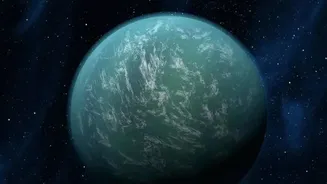
The launch and operation of the James Webb Space Telescope has been a game-changer for this field. Its unprecedented sensitivity allows it to capture incredibly detailed spectra from exoplanet atmospheres, including those of smaller, rocky worlds that were previously difficult to study. JWST has already made significant detections of methane and carbon dioxide on the exoplanet K2-18 b, a potential “Hycean” world with a hydrogen-rich atmosphere and a possible water ocean. Such discoveries are helping scientists refine what to look for and are pushing the boundaries of what can be detected.
Cosmic Caveats and False Positives
The search, however, is fraught with challenges. A key difficulty is ruling out false positives—scenarios where non-biological processes could mimic the signs of life. For example, under certain conditions, a planet's atmosphere could build up oxygen or ozone without any life being present, purely through chemical reactions driven by starlight. This is why context is critical. Scientists must consider the type of star the planet orbits, the planet’s size and temperature, and other atmospheric components to determine if a potential biosignature is truly a sign of biology or just interesting geology or chemistry. The recent tentative detection of dimethyl sulfide on K2-18 b, for instance, has been met with both excitement and caution, as follow-up analyses show the signal is not yet definitive.