


The Sun’s Volatile Temper
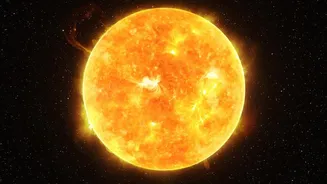
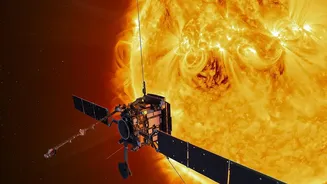
Our sun, the life-giving star at the center of our solar system, has a dynamic and often violent nature. It periodically releases enormous bursts of energy and matter known as solar storms. These events primarily take two forms: solar flares and coronal
mass ejections (CMEs). A solar flare is an intense blast of electromagnetic radiation that travels at the speed of light, reaching Earth in about eight minutes. They can cause immediate disruptions, like radio blackouts, by affecting the Earth's upper atmosphere. CMEs, on the other hand, are vast clouds of magnetized plasma and charged particles hurled into space. While slower, taking anywhere from a few hours to three days to reach us, their impact can be far more significant, triggering what are known as geomagnetic storms. These storms are disturbances in Earth's protective magnetic field, the magnetosphere, and they pose a direct threat to our technology-driven world.
A Network of Sentinels
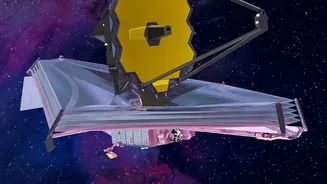
To provide early warnings, scientists rely on a sophisticated network of eyes on the sun, both in space and on the ground. Satellites are our first line of defense. Observatories like NOAA's Geostationary Operational Environmental Satellites (GOES) constantly monitor the sun, providing real-time imagery of solar flares and CMEs. Another crucial satellite, the Deep Space Climate Observatory (DSCOVR), is positioned about 1.5 million kilometers from Earth at a stable gravitational point called Lagrange Point 1 (L1). From this vantage point, it directly measures the solar wind—the constant stream of particles from the sun—and can detect the characteristics of an approaching CME, typically giving us a crucial 15 to 60-minute warning before it hits Earth. This data is supplemented by ground-based observatories that also track solar activity, creating a comprehensive, 24/7 watch.
From Deep Space to Your Device
When a powerful solar storm arrives, its interaction with Earth's magnetosphere can have cascading effects on our communication infrastructure. The high-energy particles can damage satellite electronics, leading to malfunctions or complete failure. Geomagnetic storms heat and expand the upper atmosphere, increasing the drag on satellites in low-Earth orbit, which can alter their trajectory and even shorten their lifespan. The disturbances also disrupt the ionosphere, a layer of the atmosphere crucial for bouncing high-frequency radio signals around the globe. This can cause widespread radio blackouts, particularly affecting aviation and emergency services. Furthermore, these same ionospheric changes can distort and delay GPS signals, leading to significant inaccuracies in navigation systems that are essential for everything from commercial flights to personal mapping apps on our phones.
The Race Against the Clock
At the heart of the global effort to track and predict these events is NOAA’s Space Weather Prediction Center (SWPC) in Boulder, Colorado. Operating around the clock, forecasters at the SWPC analyze a continuous stream of data from satellites and ground-based instruments. They use sophisticated computer models, like the WSA-Enlil model, to predict the path and arrival time of CMEs. Based on this analysis, the SWPC issues a series of watches, warnings, and alerts, much like the National Weather Service does for terrestrial storms. These alerts provide crucial lead time for various industries to take protective measures. This forecasting is a joint effort, often involving collaboration with partners like the U.S. Air Force to ensure that both civilian and military sectors are prepared.
A Global Shield of Information
The warnings issued by the SWPC are not just for informational purposes; they are actionable intelligence that triggers a global defense plan. When a severe geomagnetic storm is forecast, satellite operators can power down sensitive components or adjust a satellite's orientation to minimize damage. Airlines may reroute flights away from polar regions, where the effects of solar radiation are strongest and can disrupt communication with air traffic control. Power grid operators are alerted to the possibility of induced ground currents that can overload transformers and cause widespread blackouts. By providing these advance notices, space weather scientists give critical infrastructure operators the time they need to brace for impact, effectively creating a shield of information that protects the complex technological systems our modern society depends on.