
An Old Friend in New Light
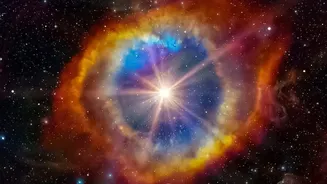
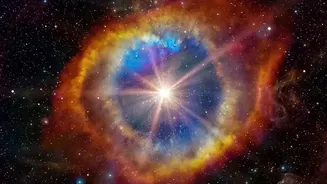
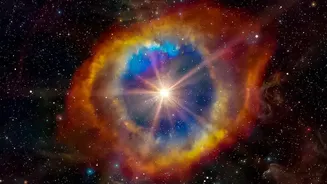
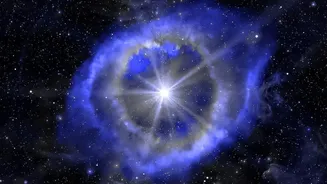
Located about 650 light-years away in the constellation Aquarius, the Helix Nebula is one of the closest and most famous examples of a planetary nebula. First spotted in the 1800s, its ghostly, eye-like appearance has earned it the nickname the "Eye of God."
For over two centuries, we've pointed our best telescopes at it, trying to understand the final, dramatic moments of a dying star. A planetary nebula, despite its name, has nothing to do with planets. It’s the beautiful, expanding cloud of gas and dust that a star like our own Sun sheds at the end of its life. At its center lies a tiny, super-hot core called a white dwarf—the star’s final remnant. While Hubble and other observatories have given us stunning views, Webb’s look is a game-changer.
Seeing the Unseen with Infrared
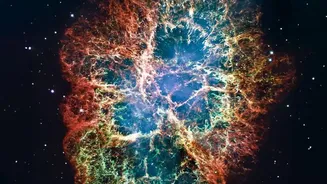
So, what makes this image so special? It comes down to how Webb sees the universe. Unlike telescopes that primarily see visible light, Webb is optimized for infrared light. This allows it to peer through cosmic dust and capture the subtle heat signatures of gas and molecular structures that are invisible to other instruments. The new image, captured by Webb’s Near-Infrared Camera (NIRCam), resolves the nebula's complex structures with staggering clarity. It reveals the stark transition from the hottest gas, blasted by radiation from the central star, to the cooler, more delicate material further out. The colors in Webb's image represent chemistry and temperature, with blue hues showing the hottest, ionized gas and reddish tones highlighting the coolest molecular hydrogen at the edges.
Unpacking the Cosmic Details
The incredible sharpness of Webb’s view brings strange and fascinating features into focus. Most prominent are the thousands of “cometary knots” that fringe the inner ring of the nebula. These are not actual comets, but dense clumps of gas and dust, each with a mass similar to Earth's but spanning a size several times larger than Pluto's orbit. For years, their exact origin has been a puzzle. Webb's image shows them in more detail than ever before, revealing them as the product of a cosmic collision. Blistering stellar winds, moving at high speed from the central star, are slamming into cooler shells of gas that the star ejected earlier in its life. This interaction sculpts the gas into the long, tail-like filaments that give the knots their cometary appearance.
A Glimpse into Our Sun's Future
Beyond its sheer beauty, the Helix Nebula offers us a profound preview of our own solar system’s distant future. In about five billion years, our Sun will exhaust its nuclear fuel and begin to die. It will swell into a red giant before shedding its outer layers to create its own planetary nebula. The Earth and other planets will be gone, but the material that once formed them will be recycled back into the cosmos. By studying the Helix Nebula, astronomers can better understand this process of cosmic recycling. The gas and dust expelled by dying stars like this one seed the galaxy with heavier elements, providing the raw materials for the next generation of stars and, potentially, new planets and new life. Webb's image isn't just a portrait of a star's death; it's a snapshot of cosmic rebirth.