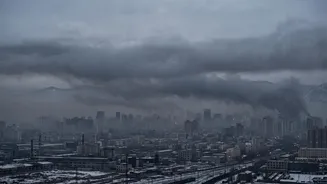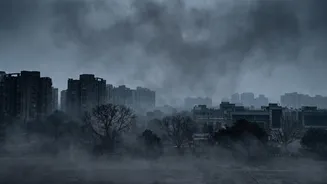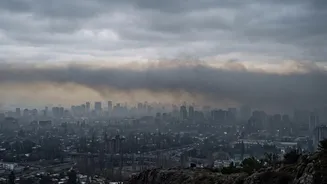




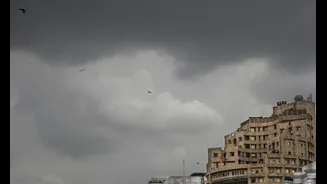
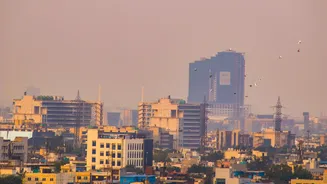
Every winter, a familiar haze descends upon cities across northern India, turning the sky a murky grey and sending air quality indices soaring. But this isn't just about more pollution being produced; it's about the air's inability to clean itself.
First, What Are Fine Particulates?
Before
we dive into the 'how', let's quickly cover the 'what'. Fine particulate matter, or PM2.5, refers to microscopic particles suspended in the air that are 2.5 micrometres or smaller in diameter—so tiny they can penetrate deep into our lungs and even enter the bloodstream. These particles come from various sources: vehicle exhaust, industrial emissions, construction dust, and smoke from crop stubble or waste burning. While these pollutants are emitted year-round, certain weather conditions can dramatically increase their concentration at ground level, where we breathe.
The Atmosphere's Winter Lid: Temperature Inversion
The single most important trapping mechanism during India's winter is a phenomenon called a temperature inversion. Normally, the air near the ground is warmer than the air above it. This warm air rises, carrying pollutants with it and dispersing them into the upper atmosphere. But during cold winter nights, the ground cools rapidly, chilling the air just above it. This results in a layer of cool, dense air being trapped beneath a layer of warmer air. This 'inversion' acts like a lid on the atmosphere, preventing pollutants from rising and scattering. Everything emitted from vehicles, industries, and fires gets trapped near the surface, accumulating throughout the night and leading to dangerously high pollution levels by early morning.
When the Air Stands Still: The Role of Wind
Another crucial factor is wind speed. In winter, especially across the vast Indo-Gangetic Plain, winds often become calm and stagnant. Strong winds are essential for horizontal dispersion, blowing polluted air away from its source and mixing it with cleaner air. When wind speeds drop below a certain threshold, typically around 10 km/h, the air mass hardly moves. This lack of movement means that pollutants linger in the same area where they are produced. Combined with a temperature inversion, low wind speeds create a perfect storm, trapping pollutants both vertically and horizontally and turning cities into 'gas chambers'.
The Shrinking Ceiling: A Lower Boundary Layer
Think of the 'boundary layer' as the volume of air near the Earth's surface where pollutants are mixed and diluted. During hot summer days, strong sunlight heats the ground, causing the boundary layer to expand to a great height, sometimes several kilometres. This large volume allows for effective dilution of pollutants. In winter, however, the lack of strong solar heating means the boundary layer is much shallower, sometimes only a few hundred metres high. This reduced 'mixing height' acts like a room with a much lower ceiling; the same amount of pollution becomes far more concentrated. Studies have shown a strong negative correlation: as the boundary layer height drops, PM2.5 concentrations shoot up.
India's Unique Pollution Cocktail
These atmospheric mechanisms are amplified by India's specific geography and seasonal human activities. The Himalayas to the north and other ranges to the south create a bowl-like topography across the Indo-Gangetic Plain, which further restricts air movement and traps pollutants. The poststmonsoon withdrawal of winds brings northwesterly flows that carry smoke from agricultural stubble burning in Punjab and Haryana directly towards Delhi and the surrounding region. When these transported pollutants arrive, they are locked in by the local trapping mechanisms of temperature inversions and low winds, coinciding with urban emissions from traffic and festive activities like Diwali, leading to the severe pollution episodes witnessed every year.