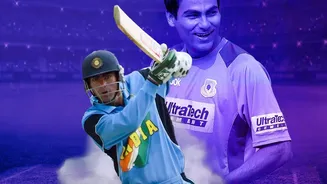




Michael Hussey: The Long Wait for Mr. Cricket
Michael Hussey's story is a masterclass in perseverance. The Australian batsman was a prolific run-scorer in domestic cricket for over a decade, but the legendary Australian team of the early 2000s had few openings. Most players make their international
debut in their early twenties; Hussey had to wait until he was 28 for his first One Day International and 30 for his Test debut. Many would have given up, but Hussey had amassed over 15,000 first-class runs by the time he earned his Baggy Green. When his chance finally came, replacing an injured Justin Langer, he grabbed it with both hands. After a quiet first match, he scored a magnificent 137 in his second Test. He quickly became a vital cog in the middle order in all formats, earning the nickname 'Mr. Cricket' for his consistency, versatility, and encyclopedic knowledge of the game. His late start did nothing to diminish his impact; he retired with a Test average over 51 and as a World Cup winner.
VVS Laxman: From Reserve to Very Very Special
Vangipurapu Venkata Sai Laxman, or VVS, had a start-stop beginning to his international career. An elegant, wristy batsman from Hyderabad, his talent was never in doubt, but he struggled to cement a permanent place in a stacked Indian middle order. Often shuffled around the batting order and sometimes left out of the team, Laxman was a fringe player for years. That all changed in March 2001. Playing against a seemingly invincible Australian team at Eden Gardens, India was forced to follow on after a batting collapse. Promoted to number three in the second innings, Laxman played what is widely regarded as one of the greatest Test innings of all time. His magical 281 not only saved India from certain defeat but, along with Rahul Dravid's 180, set up one of the most miraculous victories in cricket history. After that innings, there were no more questions. Laxman became an undisputed first-choice star, a cornerstone of India's 'Fab Four' in the middle order for the next decade.
Anil Kumble: The Unconventional Champion
When Anil Kumble first appeared on the scene in 1990, he didn't fit the mould of a leg-spinner. He was tall, wore glasses, and didn't turn the ball prodigiously like his contemporaries. Instead, he relied on pace, bounce, and relentless accuracy. After a decent debut, he was dropped and spent over two years in the wilderness. However, a stellar domestic performance brought him back into the national side in 1992, and this time, he was there to stay. Kumble's big break came during a home series against England in 1993, where he took 21 wickets in three matches, establishing himself as India's premier spinner. He was never just a backup again. For the next 16 years, 'Jumbo' was an automatic selection, becoming India's highest-ever wicket-taker in Test cricket with 619 scalps. His career proves that it's not about fitting a conventional mould, but about being relentlessly effective.
Suresh Raina: The Ultimate Team Player
Suresh Raina made his ODI debut for India at 19 but found it difficult to secure a permanent spot in the Test side, which featured legends like Tendulkar, Dravid, and Laxman. In limited-overs cricket, however, he carved out a niche as the perfect modern player. An aggressive left-handed batsman, a dynamic fielder who lifted the entire team's energy, and a useful part-time bowler, Raina made himself indispensable. He wasn't always the main star, but he was often the player who made the crucial contribution. His quick-fire innings in the quarter-final and semi-final of the 2011 World Cup were vital to India's triumph. He was the first Indian to score a century in all three formats of the game, a testament to his adaptability. Raina embodied the idea of a player who starts as a squad utility option but, through sheer will, skill, and a team-first attitude, becomes a first-choice name on the teamsheet for years.