

How to Sail on Sunlight
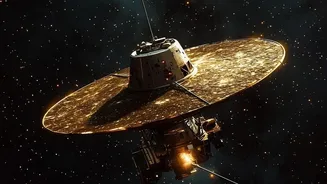
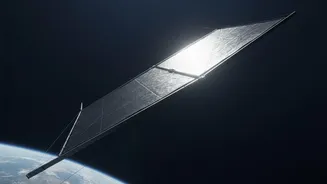
The idea of a solar sail sounds like something straight out of science fiction, but the principle is surprisingly straightforward. It works much like a sailboat on water, but instead of wind, it uses the subtle pressure of sunlight to move. Light is made
of particles called photons. While photons have no mass, they possess momentum. When a photon strikes an ultra-thin, highly reflective sail and bounces off, it transfers a tiny amount of its momentum to the sail. In the frictionless vacuum of space, this minuscule but constant push adds up. Each of the countless photons from the sun acts as a persistent nudge, gradually accelerating the spacecraft to incredible speeds over time without using a single drop of fuel.
Recent Tests Prove the Concept
While the theory has been around for decades, turning it into reliable hardware has been a long journey. Early missions like Japan's IKAROS and The Planetary Society's LightSail 2 successfully demonstrated that solar sailing was possible. More recently, NASA and its partners have been achieving significant milestones. In early 2024, a crucial ground test successfully deployed a quadrant of a massive new sail, part of the Solar Cruiser project. This test was a major step, proving the technology is mature enough for new science mission proposals. The full sail will eventually be enormous, covering an area equivalent to about four basketball courts, yet its material is thinner than a human hair. These successes build on years of learning and are paving the way for larger and more ambitious missions.
Escaping the Tyranny of the Rocket
The biggest challenge in space exploration has always been fuel. Traditional chemical rockets are governed by what’s known as the Tsiolkovsky rocket equation. In simple terms, to go farther or faster, you need more fuel. But that fuel has mass, which means you need even more fuel just to lift the initial fuel off the ground. This creates a cycle of diminishing returns, making missions to the outer solar system incredibly long and interstellar travel practically impossible with current technology. A trip to the nearest star system with our fastest current probes would take tens of thousands of years. Photon propulsion breaks this cycle entirely. By eliminating the need for on-board propellant, spacecraft can be lighter, cheaper, and capable of missions that last for years or even decades.
The Future of Exploration
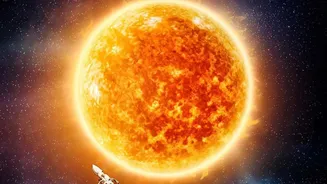
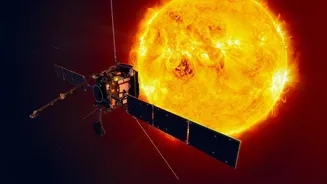
Photon sails unlock a new class of missions. In the near term, they could be used to position space-weather satellites closer to the sun, providing earlier warnings of solar storms that threaten our power grids and communications systems. Looking further ahead, the technology promises rapid transit across our solar system. By performing a close slingshot maneuver around the sun, a solar sail could accelerate to speeds that would allow it to reach Neptune in less than a year, compared to the 30-plus years it took the Voyager probes. This opens up the possibility of intercepting and studying interstellar objects that pass through our cosmic neighborhood. For the far future, the concept could be taken a step further. Instead of relying only on sunlight, powerful lasers based on Earth could be aimed at these sails, pushing tiny probes to a fraction of the speed of light and making trips to nearby stars achievable within a human lifetime.