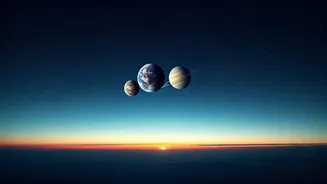



What Is a Planetary 'Lineup'?
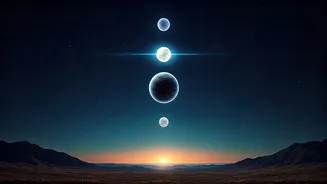
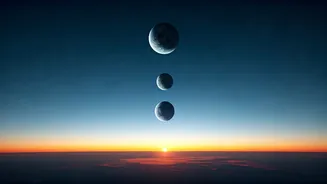
First, let's clear up a common misconception. When we talk about a planetary alignment or 'lineup', the planets aren't actually forming a straight line out in space. That would be an incredibly rare event. Instead, what we're seeing is a visual trick
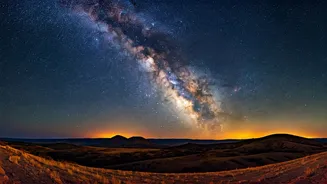
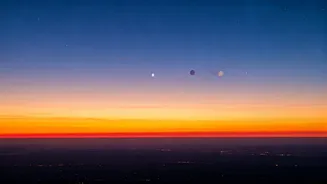
from our vantage point here on Earth. The planets, each moving in its own massive orbit around the Sun, happen to appear in the same small patch of our night sky. This phenomenon, more accurately called a conjunction or an appulse, makes them look close together. While it's an illusion of perspective, it’s a stunningly beautiful one that has captivated humans for millennia, often inspiring myths and fuelling scientific discovery.
Meet the Celestial Trio
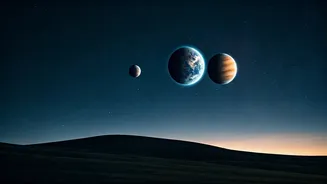
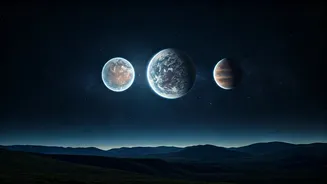
The stars of tonight's show are three familiar celestial bodies: Jupiter, Mars, and Saturn. Jupiter, the largest planet in our solar system, will be the brightest of the three, shining with a steady, brilliant white light. You can't miss it. Mars, the 'Red Planet', will be easily identifiable by its distinct reddish-orange hue. Its colour is due to iron oxide—essentially rust—on its surface. Finally, Saturn, famous for its magnificent rings, will appear as a steady, yellowish-white point of light. While its rings aren't visible to the naked eye, its presence alongside the other two giants makes for a truly special sight.
Your Viewing Guide for India
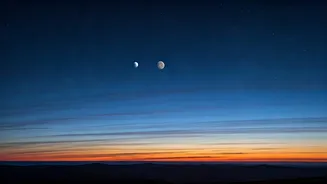
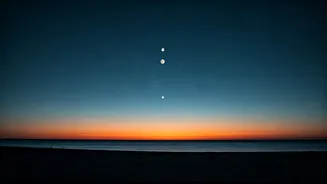
Timing and direction are everything for stargazing. For observers across India, the best time to view this planetary gathering will be in the pre-dawn hours. Start looking about 90 to 60 minutes before local sunrise. The planets will be visible in the eastern sky. To find them, face east and look for the brightest 'star' near the horizon—that will be Jupiter. Mars and Saturn will be nearby, forming a rough triangle or line depending on the exact date. The trio will rise in the east and travel across the sky as the morning progresses, but the darkness of the early morning provides the best contrast for viewing. The specific arrangement changes slightly each night, so it's worth looking for a few days in a row.
Do You Need a Telescope?
The best part about this event is its accessibility. You don't need any special equipment to enjoy it. All three planets are bright enough to be easily seen with the naked eye, even from moderately light-polluted urban areas. However, if you have a pair of binoculars, you'll get a much richer experience. With a steady hand or a tripod, binoculars might even reveal Jupiter's four largest moons—Io, Europa, Ganymede, and Callisto—as tiny pinpricks of light flanking the planet. If you have access to a small amateur telescope, the view becomes even more spectacular. You'll be able to clearly see the rings of Saturn and possibly even some cloud bands on Jupiter. But don't let a lack of gear stop you; the simple act of seeing these worlds with your own eyes is a reward in itself.
Tips for the Best Viewing Experience
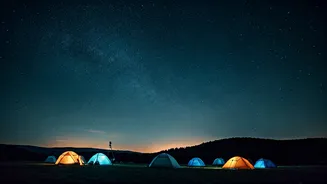
To make the most of this celestial display, a little preparation goes a long way. First, try to find a viewing spot with a clear view of the eastern horizon, away from tall buildings and bright streetlights. The darker your surroundings, the more stars and details you'll see. Give your eyes at least 15-20 minutes to fully adapt to the darkness; avoid looking at your bright phone screen during this time. If you need a light, use a red-light torch, as it's less disruptive to your night vision. You can also use a stargazing app on your phone (like Stellarium, SkyView, or Google Sky Map) before you head out. These apps use your phone's GPS to show you exactly where to look for the planets in your night sky. Just point your phone at the sky, and the app will identify everything for you.