

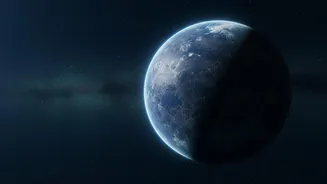
A Breakthrough Discovery
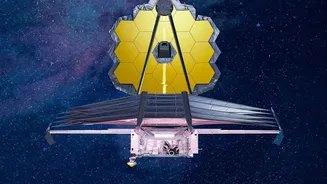
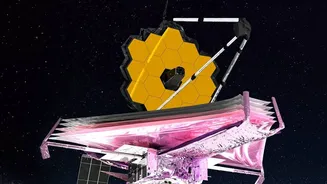
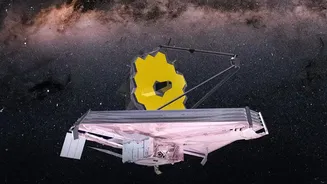
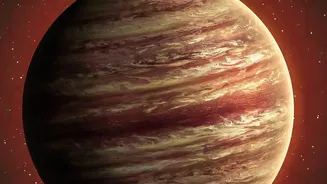
In a landmark finding, astronomers using the JWST have confirmed the presence of a water-rich atmosphere on GJ 9827 d, an exoplanet nearly 100 light-years away. This world, about twice the size of Earth, is the smallest exoplanet to date where water vapour
has been so clearly detected. While earlier observations from the Hubble Space Telescope had hinted at water, Webb’s superior technology provided the definitive proof. This is a huge milestone because most atmospheres we’ve been able to study belong to gas giants like Jupiter. Detecting the atmosphere on a smaller, potentially rocky world is a massive technological leap forward, proving the tools designed to find habitable worlds actually work.
How Webb Reads an Alien Sky
So, how does the telescope 'see' water from trillions of kilometres away? The technique is called transmission spectroscopy. Think of it like a cosmic barcode scanner. When a planet passes in front of its star from our point of view (a 'transit'), the starlight filters through the planet's atmosphere. Different gases and molecules in that atmosphere absorb very specific colours, or wavelengths, of light. The JWST’s sensitive instruments, called spectrographs, capture the starlight and spread it into a rainbow, or spectrum. By looking for the exact colours of light that are missing, scientists can identify the chemical fingerprint of the atmosphere—in this case, revealing the unmistakable signature of water vapour.
A 'Steam World,' Not an Ocean Planet
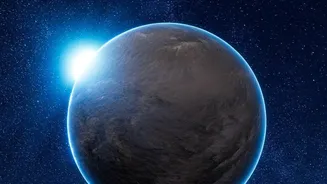
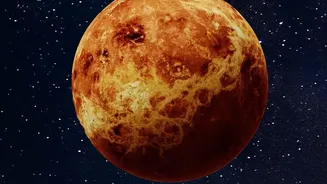
It’s important to clarify what 'water-rich' means in this context. GJ 9827 d is far too hot for life as we know it, with a surface temperature around 430 degrees Celsius, similar to Venus. At that temperature, any water would exist as a thick, oppressive steam. Scientists have dubbed GJ 9827 d a potential 'steam world'—a planet with an atmosphere almost entirely composed of water vapour. This isn't a world with sparkling blue oceans and fluffy white clouds. Instead, it's likely a sweltering, high-pressure environment. The discovery is exciting not because this specific planet is habitable, but because it confirms that planets with dense, water-heavy atmospheres can and do exist, which was once only a theory.
The Search for Earth 2.0
The successful analysis of GJ 9827 d’s atmosphere is a dress rehearsal for the main event: finding a true Earth-like planet. Webb’s spectrographs are not limited to detecting water. They can also identify other crucial molecules like methane, carbon dioxide, and ammonia. Some of these, in the right combination, could be 'biosignatures'—indirect signs of life. Finding water is just the first step on a long checklist. The next is to point the telescope at rocky planets orbiting in their star's 'habitable zone,' where temperatures are just right for liquid water to exist on the surface. Webb has now proven it has the precision to do this for smaller, rocky worlds, bringing the search for Earth 2.0 out of science fiction and into the realm of observational science.