





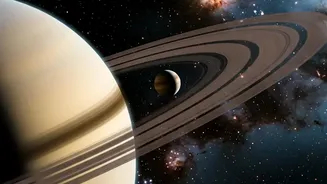
The Case for Young Rings
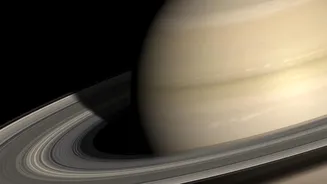
For a long time, the prevailing theory was that Saturn’s rings were young, perhaps only 100 million to 400 million years old. This would mean they formed around the time dinosaurs roamed the Earth, making them a relatively new feature compared to the 4.5-billion-year-old
planet they orbit. This conclusion was largely based on data from NASA's Cassini spacecraft, which studied Saturn from 2004 to 2017. The key piece of evidence was the rings' cleanliness. They are made of about 98% pure water ice, which scientists argued should have become significantly darker over billions of years due to constant bombardment by tiny, dark micrometeoroids. The pristine brightness of the rings suggested they simply hadn't been around long enough to get dirty. This reasoning was bolstered by measurements of the mass of the rings and the rate at which material is raining down onto Saturn, which suggested they are ephemeral and losing mass over time.
A New Theory Questions Everything
However, recent research has thrown a wrench into this tidy narrative. A study published in late 2024 proposes that the rings could be as old as Saturn itself—around 4.5 billion years. A Japanese-led team suggests that the rings aren't clean because they are young, but because they are exceptionally good at staying clean. Using computer models, these researchers demonstrated that when micrometeoroids strike the icy ring particles, they don't just leave behind a layer of dark dust. Instead, the impact vaporizes the micrometeoroids. According to this model, the resulting charged particles are then either pulled into Saturn's atmosphere or ejected into space, effectively acting as a self-cleaning mechanism that keeps the rings looking perpetually young and bright.
The Heart of the Debate
The disagreement highlights how difficult it is to determine the age of celestial objects indirectly. Both sides are largely interpreting data from the same Cassini mission, but they are using different models and assumptions. The 'young ring' proponents, led by researchers like Sascha Kempf at the University of Colorado Boulder, point to the measured influx of dust as a kind of cosmic clock. They collected just 163 dust grains over 13 years, but from that, they calculated it would only take a few hundred million years for the rings to accumulate the small amount of non-icy material they contain today. On the other hand, the 'old ring' advocates, such as Ryuki Hyodo from the Institute of Science in Tokyo, argue that the physics of the impacts themselves have been misunderstood. If their self-cleaning model is correct, then the entire premise of using dust accumulation to measure age is flawed. This leaves the scientific community with two compelling but conflicting explanations for why the rings appear so pristine.
Why the Age of the Rings Matters
This debate is about more than just a planetary birthday. The age of Saturn's rings provides crucial insight into the history and evolution of our solar system. If the rings are ancient, it suggests they formed from the original disc of gas and dust that created the planets. It would also imply that such grand ring systems could be a common and long-lasting feature of giant planets. Conversely, if the rings are young, it points to a much more dynamic and potentially violent recent history in the outer solar system. A young ring system would likely be the result of a cataclysmic event, such as an icy moon wandering too close to Saturn and being torn apart by its gravity, or a collision between moons. Knowing which scenario is correct helps planetary scientists piece together the timeline of how our cosmic neighborhood came to be, and whether we are simply lucky to be alive at a time when Saturn is so beautifully adorned.