
The High-Stakes Hunt for Lunar Water
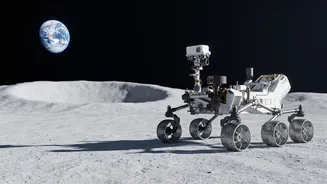
For decades, scientists have known that water ice likely exists on the Moon, hidden in permanently shadowed regions (PSRs) near the poles where sunlight has not reached for billions of years. This isn't just about giving future astronauts something to
drink. Lunar ice is the ultimate multi-purpose resource. It can be split into hydrogen and oxygen, providing breathable air for habitats and the ingredients for rocket propellant. Finding accessible water on the Moon could dramatically reduce the cost and complexity of future space exploration, enabling a sustainable human presence and even supporting missions to Mars. The challenge, however, has always been finding it. These PSRs are incredibly cold and dark, making them difficult to study. Previous methods relied on manually sifting through vast amounts of data from different missions or using specialized algorithms that were difficult to adapt.
An AI Tool for a New Era of Exploration
Enter the NASA-IBM Lunar Foundation Model. This isn't just another specialized algorithm; it's a foundational AI model pre-trained on petabytes of data from multiple lunar missions, including NASA's Lunar Reconnaissance Orbiter (LRO). Think of it as a digital Rosetta Stone for lunar science. It has learned to interpret and combine more than 30 different layers of data—from high-resolution imagery to temperature and gravity maps—into a single, unified format. Because the model is open-source and publicly available, it gives researchers around the world a powerful, adaptable tool to analyse the Moon's surface faster and more efficiently than ever before. NASA officials have highlighted that collecting data is only half the battle; this AI represents a major step in making that data more usable for new discoveries.
Seeing What Other Tools Have Missed
The key advantage of the new AI model is its ability to see patterns across different datasets that were previously hidden. Instead of just looking for the bright reflections characteristic of surface ice, the model analyses a combination of features to predict where ice is likely to be stable, both on the surface and just below it. In benchmark tests, the model proved to be significantly more accurate than previous methods, reducing errors in identifying areas with high potential for lunar ice by up to 22 percent. This enhanced accuracy could help scientists create the first comprehensive water resource maps of the Moon, identifying not just the largest deposits but also smaller, more scattered patches that were previously overlooked.
More Than Just an Ice Detector
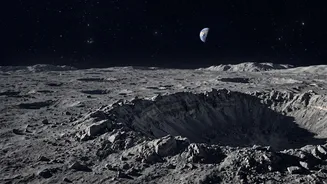
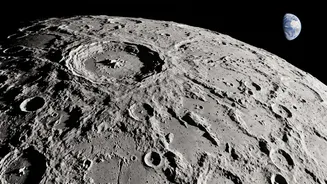
While finding water is a primary goal, the AI's capabilities extend far beyond that. The model can also be used to map craters with much greater efficiency, which is crucial for dating the lunar surface and selecting safe landing sites for future missions like Artemis. By identifying even small, previously unrecorded craters, it can help reconstruct the history of asteroid impacts in our solar system. Furthermore, the AI helps scientists study the Moon's volcanic past by mapping unusual features known as irregular mare patches. Understanding the age and distribution of these features could help resolve long-standing debates about how the Moon cooled and evolved over billions of years.
Powering the Future on the Moon
Ultimately, the NASA-IBM Lunar Foundation Model is a strategic tool for infrastructure planning. By automating the detection of critical resources and hazards, it provides essential data for NASA's Artemis program, which aims to establish a long-term human presence on the Moon. Knowing precisely where to find water ice means NASA and its commercial partners can better plan the locations for lunar bases and mining operations. This capability to live off the land, known as in-situ resource utilization (ISRU), is fundamental to making deep space exploration economically feasible. The AI doesn't just give us a better map; it offers a clearer roadmap to building a future for humanity beyond Earth.