




The Problem with Paradise
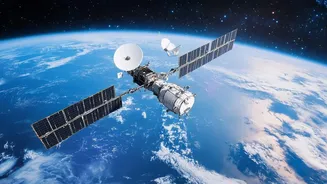
Very-low Earth orbit (VLEO), an altitude range roughly 150 to 400 kilometres up, is prime real estate in space. Satellites this close to the planet can capture incredibly high-resolution images, provide faster communications with lower latency, and gather
more detailed scientific data. There’s just one major problem: it’s not a true vacuum. The residual atmosphere, though incredibly thin, creates persistent drag on any satellite, slowing it down and causing its orbit to decay. To stay aloft, satellites need to fire thrusters, but this requires carrying a finite amount of propellant. When the fuel runs out, the mission is over. This fundamental limitation has made long-duration missions in these valuable orbits impossible.
Turning a Foe into Fuel
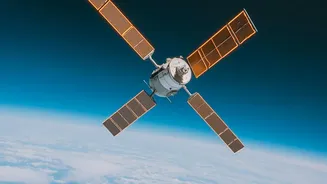
Air-breathing electric propulsion (ABEP) offers a revolutionary solution. Instead of carrying its own propellant, an ABEP-equipped satellite uses the very atmospheric particles that cause drag as its fuel source. The concept involves a special intake that collects the scarce air molecules—mostly atomic oxygen and nitrogen—and funnels them into an electric thruster. This approach transforms the primary challenge of VLEO operations into a mission-extending advantage. It effectively gives the satellite an unlimited fuel tank, allowing it to compensate for drag and potentially remain in orbit for years instead of months or weeks.
How an 'Air-Breather' Works
The process is elegant in its efficiency. As the satellite speeds through the upper atmosphere, an intake, which looks something like a funnel, scoops up the ambient air molecules. These captured particles are then guided into a chamber where they are ionized—that is, given an electrical charge by a system powered by the satellite's solar panels. Once ionized, these particles can be manipulated by electric and magnetic fields. The electric thruster then accelerates these newly created ions and expels them at high velocity, generating thrust that counteracts atmospheric drag. The system essentially inhales the atmosphere and exhales it to push itself forward.
A New Class of 'Perpetual' Missions
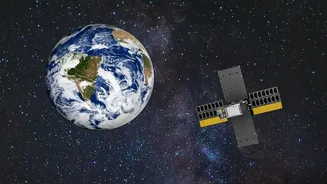
The implications of this technology are vast. Satellites capable of sustained flight in VLEO could enable persistent, high-resolution Earth observation for climate monitoring, agriculture, and disaster response. Telecommunication companies could offer even lower-latency internet services. For defence and security, it means the ability to maintain continuous surveillance over specific areas. Furthermore, the technology promises a more sustainable use of space. Since these satellites operate in a 'self-cleaning' orbit where atmospheric drag ensures any debris deorbits quickly, it mitigates the growing problem of space junk in higher orbits.
From Theory to Tangible Tech
What was once just a concept is now a tangible technology, with several space agencies and private companies making significant progress. The European Space Agency (ESA) has been a key player, successfully test-firing a prototype as early as 2018 that demonstrated the feasibility of using atmospheric propellant. Since then, various projects funded by the EU and national space agencies, like the UK Space Agency, have advanced the technology, developing and testing critical components like electrode-less thrusters that promise longer operational lifetimes. Companies are now moving toward developing integrated systems for small satellites, marking a transition from research to demonstration.
Challenges on the Horizon
Despite the promise, ABEP technology is not a silver bullet. The systems can only operate in a narrow altitude band where the atmosphere is dense enough to provide propellant but not so dense that the drag overwhelms the thrust the engine can produce. Furthermore, the atomic oxygen prevalent at these altitudes is highly corrosive, posing a significant material science challenge for the satellite and its intake system. Developing a system that is efficient, durable, and powerful enough to consistently compensate for drag remains a complex engineering hurdle that researchers are actively working to overcome.