


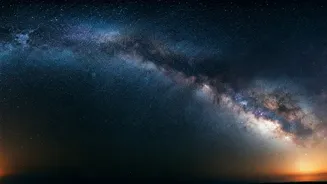
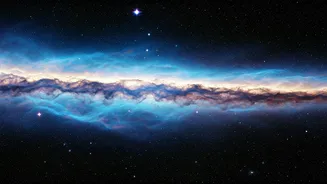


A Journey Through Time, Not Space
We often talk about the immense distances in space, but it's the element of time that truly bends the mind. Light, while the fastest thing in the universe, is not instantaneous. It travels at a blistering speed of nearly 300,000 kilometres per second,
a velocity that could circle the Earth over seven times in a single second. Yet, the cosmos is so vast that this incredible speed is reduced to a cosmic crawl. To measure these distances, astronomers use the light-year—the distance light travels in one year, which is about 9.5 trillion kilometres. When we hear a star is 10 light-years away, it doesn’t just mean it’s incredibly far. It means the light we are seeing tonight left that star 10 years ago. Every star in the sky is, therefore, a portal to the past.
History Written in Starlight
This principle turns the night sky into a living museum of history. Take, for instance, Dhruva Tara, the North Star, also known as Polaris. It is approximately 433 light-years away. The faint, steady light you see from it tonight began its journey to your eyes around the year 1591. As that photon of light began its voyage, the Mughal Empire was flourishing under Emperor Akbar. William Shakespeare was writing his first plays in England. The world that photon left behind is a world we only know from history books. By the time the light reaches us, we are seeing the star not as it is today, but as it was centuries ago. This is true for every single star you can see. The nearby star Sirius, the brightest in our sky, is 8.6 light-years away; its light is from 8.6 years ago. The brilliant Vega is 25 light-years away; we see it as it was when the internet was just becoming a household name.
Echoes from a Million Years Ago
The scale becomes even more staggering when we look beyond individual stars to entire galaxies. With the naked eye, on a very dark, clear night, you might be able to spot a faint, fuzzy patch of light. This is the Andromeda Galaxy, our nearest major galactic neighbour. That smudge of light is 2.5 million light-years away. The light you are seeing from it began its journey when our earliest human ancestors, the species Homo habilis, were first walking the Earth. That light has travelled through intergalactic space for two and a half million years, witnessing the entire evolution of humanity from a vast distance, only to end its journey in your retina. It’s a message from a time before human civilisation, before language, before fire was even mastered.
A Ghost in the Sky?
This cosmic time lag has a fascinating and slightly eerie consequence: a star you are looking at might not even be there anymore. Stars, like all things, have a life cycle. Massive stars end their lives in spectacular explosions called supernovae. A star like Betelgeuse, the reddish star in the Orion constellation, is a prime candidate. It is about 640 light-years away and is known to be in the final stages of its life. It could have exploded 100 years ago, 500 years ago, or even yesterday. But because it is 640 light-years away, we wouldn't know it. We would continue to see its steady light as if nothing had happened. Then one day, 640 years after the actual event, the light from its magnificent explosion will finally reach Earth, and the star will suddenly brighten into one of the most brilliant objects in the sky for a few weeks, before fading away forever. We are, in essence, watching a ghost.