



What is Everyday Strength?
Everyday strength, often called functional fitness, isn't about lifting the heaviest weights or sculpting perfect muscles. It's about training your body for the movements you perform in real life. Think about squatting to pick something up, reaching for an
item on a high shelf, or carrying heavy bags from the market. Functional fitness focuses on exercises that mimic these exact motions, improving your coordination, balance, and core stability. The goal is to make daily activities easier, reduce the risk of injury, and enhance your overall quality of life. By training movement patterns rather than isolating individual muscles, you build strength that is practical and directly applicable to your day-to-day world.
The Foundational Squat
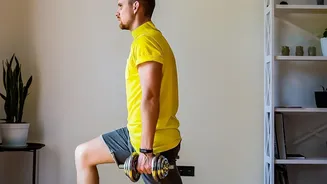
The squat is one of the most fundamental human movements. You do it every time you sit down and stand up. Mastering the bodyweight squat builds powerful legs and a strong core, making everything from getting out of a chair to lifting heavy boxes safer and easier. To perform one, stand with your feet shoulder-width apart. Hinge at your hips and bend your knees as if you're sitting in a chair, keeping your chest up and your back straight. Go as low as you can comfortably, then push through your heels to return to the starting position. For beginners, practicing with a real chair underneath can help perfect the form.
Mastering the Push-Up
The push-up is a powerhouse exercise for the upper body and core. It builds the strength needed for pushing open a heavy door, getting up off the floor, or even pushing a car. It works the chest, shoulders, triceps, and abdominal muscles all at once. Start in a plank position with your hands directly under your shoulders. Lower your body until your chest is close to the floor, keeping your body in a straight line from head to heels. Then, push back up. If a full push-up is too difficult, you can modify it by placing your knees on the floor. This reduces the weight you are pushing but still builds essential strength.
The All-Important Plank
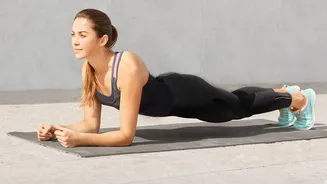
A strong core is the foundation of almost every movement you make, and the plank is one of the best exercises to build it. Core strength provides stability for your spine, improving posture and reducing the risk of back pain. To do a plank, hold a push-up position, either on your hands or your forearms, keeping your body in a rigid, straight line. Engage your abs and glutes, and resist the urge to let your hips sag. Hold the position for as long as you can maintain good form, starting with 20-30 seconds and gradually increasing the time.
Lifting and Carrying Strength
Many daily tasks involve lifting and carrying objects. You can simulate this with exercises that challenge your grip and posture. An easy at-home version of the 'farmer's walk' can be done using grocery bags, water bottles, or any object with a handle. Simply hold a weight in each hand and walk, focusing on maintaining an upright posture with your shoulders back. Another excellent exercise is the glute bridge, which strengthens the posterior chain—the muscles on the back of your body. Lie on your back with knees bent, and lift your hips toward the ceiling, squeezing your glutes at the top. This helps prepare your body for lifting tasks.
How to Keep Making Progress
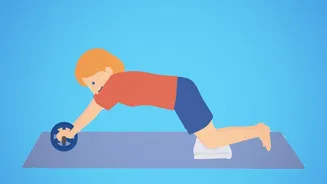
The key to getting stronger is a principle called progressive overload, which means gradually making your workouts more challenging. Without weights, you can still apply this principle effectively. The simplest method is to increase the number of repetitions (reps) or sets you perform. You can also decrease your rest time between sets, which forces your muscles to adapt. Another effective technique is to change the tempo of the exercise, for example, by slowing down the lowering phase of a squat or push-up to increase the time your muscles are under tension. As you get stronger, you can also move to more challenging variations, such as progressing from knee push-ups to full push-ups or trying single-leg squats.