





The Universe's Standard Blueprint
For decades, scientists have had a remarkably successful framework for understanding the cosmos, known as the Lambda-Cold Dark Matter (ΛCDM) model. Think of it as the master blueprint for the universe. It explains everything from the faint afterglow of the Big
Bang to the large-scale structure of galaxies we see today. A core principle of this model is that structure forms hierarchically. Small things, like stars and small galaxies, form first. Over billions of years, gravity pulls these smaller structures together, gradually building massive galaxy clusters. It's a slow, methodical construction project on a cosmic scale. This model has been incredibly successful, but its success depends on this slow-and-steady growth.
An Object That Shouldn't Exist (Yet)
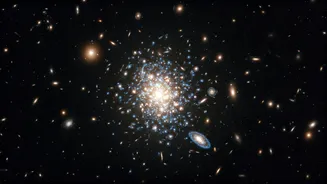
Enter XLSSC 122. This isn't just any galaxy cluster. Thanks to the powerful vision of the James Webb Space Telescope (JWST), we are seeing it as it was 10.4 billion years ago, when the universe was only about three billion years old. This era is known as 'cosmic noon', a time when star formation was at its peak, and the first major structures were thought to be in their messy, adolescent phase. But XLSSC 122 doesn't look like an adolescent. It appears surprisingly mature, with a core that is incredibly dense and massive. In fact, its core is so concentrated that its gravity bends the light of galaxies behind it, a phenomenon known as strong gravitational lensing. It is the most distant cluster ever found to be doing this. According to the standard ΛCDM model, it simply shouldn't have had enough time to become so well-organized.
Too Mature, Too Soon
The problem with XLSSC 122 is that its mass is too concentrated, too early in the universe's history. Recent papers led by researchers like Kyle Finner of Caltech have confirmed this unsettling observation. The standard ΛCDM model predicts a much slower assembly. Finding a cluster this developed at cosmic noon is like finding a fully-built skyscraper in a town that, according to your maps, should only have the foundations laid. Further evidence from the JWST revealed the faint glow of 'intracluster light'—stars that have been stripped from their home galaxies during mergers. This is the earliest such light has ever been detected, providing a clear sign that this cluster was already a bustling, chaotic site of galaxy collisions when the universe was still young.
Does This Break Cosmology?
Not so fast. As scientists are quick to point out, one anomalous object is not enough to overturn a model as robust and well-tested as ΛCDM. XLSSC 122 could be a statistical fluke—a one-in-a-billion cluster that happened to form in an unusually dense patch of the early universe. More observations of similar objects are needed to see if this is a trend or an exception. However, it does put real pressure on the existing model. It suggests that the process of structure formation, particularly the role of dark matter in pulling things together, might be more rapid or efficient in the early universe than previously thought. It doesn't break the blueprint, but it suggests there might be a crucial annotation missing from the first few pages.