

A Faint New Member of the Family
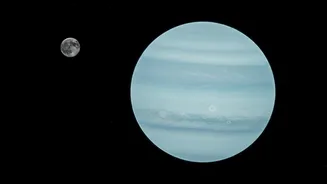
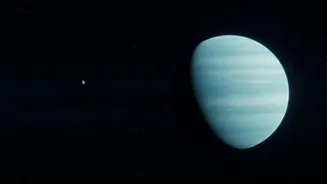
The newly found moon, provisionally designated S/2023 U1, is a cosmic speck. At just eight kilometres in diameter, it is likely the smallest of Uranus's 28 known moons. It is so faint that its discovery required special image processing techniques by
astronomer Scott S. Sheppard, using powerful ground-based telescopes in Chile. The discovery was a painstaking process, first spotted in November 2023 and then confirmed by finding it in older images from 2021 once its orbit was calculated. This tiny world takes about 680 Earth days to complete a single trip around its parent planet. Once confirmed, it will likely be named after a character from a Shakespeare play, following the tradition for Uranian moons.
An Orbit That Breaks the Rules
What makes S/2023 U1 so fascinating to astronomers is not its size, but its path. Unlike Uranus's larger, more well-known moons like Titania and Oberon, which circle the planet in a relatively flat plane, this new moon follows a highly unusual orbit. Its path is both eccentric, meaning it's a stretched-out oval rather than a neat circle, and highly inclined. Imagine most moons orbiting on a flat disc, like a record on a turntable; S/2023 U1 loops far above and below this plane at a steep angle. Orbits like this are a tell-tale sign that a moon is an 'irregular' satellite, and it holds clues about its mysterious origins.
A Captured Wanderer from the Past
The unusual orbit strongly suggests that S/2023 U1 was not born alongside Uranus. Instead, it was almost certainly a 'captured' object. This means it likely originated in the Kuiper Belt—the vast ring of icy bodies beyond Neptune—and wandered too close to Uranus billions of years ago. The ice giant's immense gravity ensnared the object, pulling it into the strange, looping orbit we see today. This makes it a cosmic relic, a preserved piece of the early solar system. Studying its composition and path allows scientists to essentially look back in time, helping them model the dynamic and chaotic environment when the planets were still forming.
Clues to a More Violent History
The discovery of S/2023 U1 and its membership in a family of similar irregular moons reinforces a key theory: the outer solar system was a much more violent and messy place than it is today. Its orbit is similar to two other Uranian moons, Caliban and Stephano. Astronomers believe these groupings are the result of an ancient collision where a larger captured moon was shattered by an impact with an asteroid or comet, leaving behind smaller fragments in similar orbits. Every new irregular moon helps piece together this dramatic history, revealing how the gravitational pull of giant planets shaped their satellite systems by capturing and sometimes destroying wandering objects. These discoveries confirm that Uranus, despite being tipped on its side, has an outer moon system similar to the other gas giants like Jupiter and Saturn.
The Case for a Closer Look
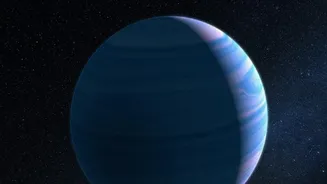
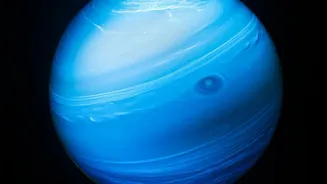
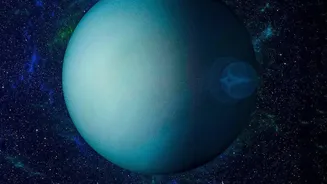
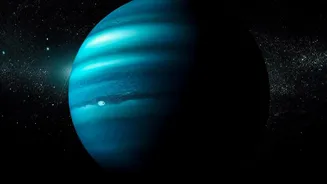
Uranus remains one of the most mysterious planets in our solar system, having been visited by only one spacecraft, Voyager 2, back in 1986. Discoveries like S/2023 U1, made from telescopes on Earth, highlight just how much there is still to learn. For this reason, a dedicated mission to Uranus has become the highest priority for a major NASA flagship mission in the coming decade. A future Uranus Orbiter and Probe would study the planet, its rings, and its fascinating moons in unprecedented detail. Examining captured moons like S/2023 U1 up close could provide transformative insights into the formation of not just our solar system, but planetary systems throughout the galaxy.