






A New Space Race for Data
For decades, space in India was synonymous with the Indian Space Research Organisation (ISRO). But recent policy changes, most notably the Indian Space Policy 2023, have opened the final frontier to private enterprise. This has catalysed a boom, with hundreds
of new space-tech startups emerging. While companies building rockets have grabbed headlines, another group is focused on what happens once we're in orbit. They are building and launching sophisticated satellites designed for Earth Observation (EO) — the science of gathering information about our planet from above. This market is projected to grow significantly, with some forecasts predicting the Indian EO market could reach nearly USD 380 million by 2030. These startups aren't just launching hardware; they are building the foundation for a data-driven economy, providing crucial insights to industries from agriculture to national security.
The Pioneers of a Sharper Vision
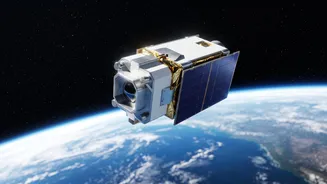
At the forefront of this movement are innovative companies like Pixxel and GalaxEye. Bengaluru-based Pixxel is building a constellation of hyperspectral imaging satellites. Unlike a standard camera that sees in red, green, and blue, Pixxel's satellites capture images across hundreds of spectral bands, revealing information invisible to the naked eye. This technology can act as a 'health monitor for the planet,' detecting everything from crop diseases weeks before they become visible to identifying mineral deposits or even invisible gas leaks. Meanwhile, GalaxEye, another Bengaluru startup founded by IIT Madras alumni, has developed the world's first 'OptoSAR' satellite. This technology uniquely combines optical sensors (like a camera) with Synthetic Aperture Radar (SAR), which can see through clouds and at night. This fusion provides all-weather, day-and-night imaging, a capability critical for disaster management and defence.
Data That Drives Decisions on the Ground
The true value of these satellites lies in the data they provide and its real-world applications. For India's vast agricultural sector, this technology is a game-changer. Hyperspectral imagery from companies like Pixxel can monitor crop health, detect nutrient deficiencies, and help farmers improve yields with precision. In the fight against climate change, this data can monitor deforestation, track pollution sources, and measure environmental degradation with unprecedented accuracy. Urban planners can use high-resolution satellite data to monitor infrastructure projects and manage urban sprawl. For national security and disaster response, the ability to get clear, consistent imagery regardless of weather conditions is invaluable for monitoring borders and assessing damage from floods or cyclones. These startups are not just selling images; they provide actionable intelligence through sophisticated data analytics platforms, often powered by AI.
An Ecosystem Fueled by Policy and Capital
This surge in innovation isn't happening in a vacuum. The Indian government has actively fostered this growth. The establishment of IN-SPACe (Indian National Space Promotion and Authorisation Centre) created a single-window agency to promote and regulate private space activities, making it easier for startups to operate. Furthermore, liberalised Foreign Direct Investment (FDI) policies have allowed up to 74% automatic investment in satellite manufacturing and operations, attracting crucial capital. This supportive environment has enabled companies like Dhruva Space, which focuses on satellite platforms and ground infrastructure, to flourish and even collaborate with other startups on ambitious projects. One such initiative, 'Prithvi Drishti,' sees four companies—Pixxel, Piersight, Satsure, and Dhruva Space—collaborating to build a 12-satellite constellation, showcasing the maturity and collaborative spirit of India's private space ecosystem.