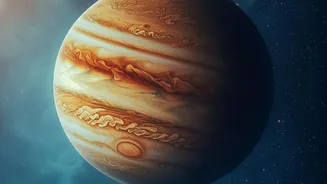




The dancing Northern and Southern Lights on Earth are a familiar wonder. But halfway across the solar system, Jupiter hosts an auroral light show so vast and powerful it makes our own look like a flickering candle in a hurricane.
A Different Kind of Engine
On Earth, auroras are
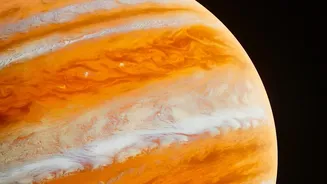
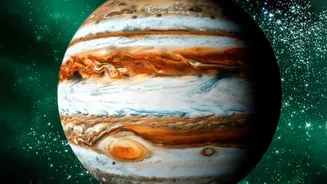
a beautiful side effect of the solar wind. Charged particles from the Sun get funnelled by our planet’s magnetic field towards the poles, where they strike atmospheric gases and make them glow. While the solar wind does play a role at Jupiter, the gas giant’s light show is driven by a much more powerful and local source. Jupiter’s auroras are hundreds of times more energetic than Earth’s and are a permanent feature at its poles. Unlike the fleeting displays on our home planet, Jupiter’s lights never go out. This fundamental difference is due to a unique combination of its immense size, rapid rotation, and a hyperactive neighbour.
The Volcanic Moon Fuelling the Fire
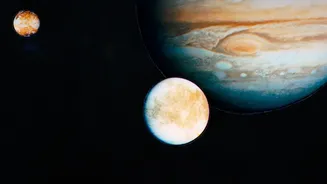
The primary ingredient for Jupiter’s main auroral displays comes from its innermost large moon, Io. As the most volcanically active body in the solar system, Io constantly spews enormous plumes of sulfur and oxygen into space. Jupiter’s colossal magnetic field, which is about 20,000 times stronger than Earth’s, sweeps up about a tonne of this volcanic material every single second. This material becomes an electrically charged plasma, forming a massive doughnut-shaped ring around Jupiter that co-rotates with the planet. This stands in stark contrast to Earth's auroras, which are primarily fed by particles from the Sun.
An Electrical Tug-of-War
Jupiter spins incredibly fast, completing a day in just under 10 hours. As it rotates, it attempts to drag the plasma cloud from Io along with it. This creates a gigantic electrical circuit and an electromagnetic tug-of-war. The immense forces involved accelerate the trapped particles to incredible speeds, funnelling them down the magnetic field lines toward Jupiter’s poles. When these high-energy ions—mostly sulfur and oxygen—slam into the upper atmosphere, they unleash a torrent of energy, creating the most powerful auroras in the solar system. The energy in these displays is sometimes enough to briefly power all of human civilization.
Mysterious Pulsing X-Rays
Beyond the ultraviolet light of the main auroral ovals, Jupiter also produces mysterious, pulsating auroras in X-ray wavelengths. For decades, scientists were puzzled by what could generate such high-energy light. Recent observations combining data from NASA’s Juno spacecraft and the XMM-Newton observatory have finally solved the 40-year-old mystery. These X-ray flares are not directly caused by Io, but by periodic vibrations in Jupiter’s magnetic field, likely triggered by interactions with the solar wind. These vibrations create electromagnetic waves that cause heavy ions trapped far out in the magnetosphere to 'surf' down into the atmosphere, creating the pulsing X-ray light shows. Researchers were surprised to find this mechanism is surprisingly similar to what causes some ion auroras on Earth, just on a vastly more energetic scale.
Footprints of the Moons
Adding another layer of complexity, the main auroral rings are accompanied by smaller, distinct bright spots known as 'auroral footprints'. These are created by an electrical current flowing along magnetic field lines that connect Jupiter directly to its large moons, primarily Io but also Europa and Ganymede. As Io moves through Jupiter’s magnetic field, it acts like a generator, creating a powerful electrical current of about one million amperes that flows to the planet. Where this current hits the atmosphere, it creates a persistent glowing spot that precisely tracks the moon's position, like an ethereal shadow. These footprints, along with strange 'dawn storms' and other newly discovered features, show that Jupiter’s auroral system is far more complex and dynamic than previously imagined.