


A New Cosmic Detective Tool
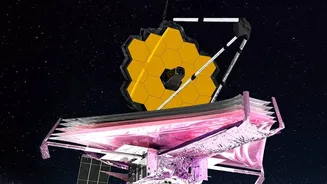
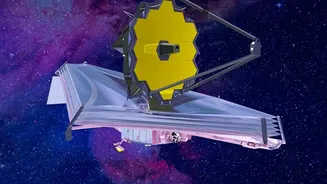
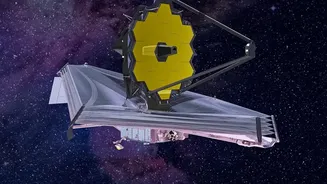
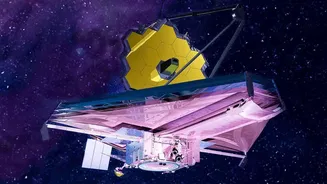
The James Webb Space Telescope (JWST) has revolutionised astronomy by giving us the ability to analyse the atmospheres of planets hundreds of light-years away. One of its most powerful new techniques involves looking not just at what elements are present,
but what kind of elements. Recently, scientists have been focusing on carbon, a fundamental building block for life. By measuring the atmospheric composition of exoplanets—planets outside our solar system—JWST is providing insights into how these worlds formed. The detection of carbon dioxide and other carbon-bearing molecules on planets like WASP-39 b and in systems like HR 8799 has been a major breakthrough. These findings prove that the telescope can identify key gases even across vast cosmic distances, setting the stage for even more detailed investigations.
What is 'Heavy Carbon'?
Not all carbon atoms are created equal. The most common form is Carbon-12, which has six protons and six neutrons in its nucleus. However, a rarer, heavier version called Carbon-13 exists, which contains an extra neutron. This 'heavy carbon' behaves chemically just like its lighter sibling but its slight extra mass can be detected by sensitive instruments like those on the JWST. The ratio of Carbon-12 to Carbon-13 in a planet's atmosphere can tell a fascinating story. On Earth, for example, life shows a preference for the lighter Carbon-12, which means that biological processes can alter this natural ratio. While we are still far from detecting such signs on exoplanets, the ability to measure these isotopes at all is a huge leap forward.
Clues to a Planet's Birthplace
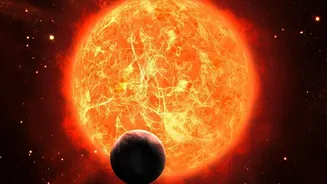
The amount of heavy carbon found in a planet's atmosphere can offer powerful clues about where in its solar system it originally formed. Scientific models suggest that planets forming in the frigid outer reaches of a solar system, far from their star and beyond the 'snow line' where ices can form, would accumulate materials rich in heavy carbon. For instance, observations of the exoplanet TYC 8998-760-1 b, a gas giant more than 150 times farther from its star than Earth is from the Sun, revealed an atmosphere with double the expected abundance of Carbon-13. This strongly suggests the planet formed in the cold, icy depths of its system, where carbon monoxide ice was likely rich in this heavier isotope. This provides a new way for scientists to reconstruct the history of planetary migration and formation.
Reshaping Our Understanding of Planetary Ingredients
JWST isn't just looking at fully formed planets; it's also examining protoplanetary disks, the swirling clouds of gas and dust where new planets are born. In one young star system, ISO-ChaI 147, the telescope found the richest collection of carbon-based molecules ever seen in such a disk, including the first detection of ethane outside our solar system. The findings suggest that the gas in this disk is extremely rich in carbon. This has a surprising implication: if most of the carbon is in the gas, there may be very little left in the solid materials that clump together to form rocky planets. This could mean that planets forming in such an environment may end up being 'carbon-poor', much like Earth. This discovery challenges previous assumptions about the chemical makeup of planet-forming environments.