



Beyond Just Clouds: The Three Foes of Stargazing
While a clear, cloudless sky is the most obvious requirement, two other crucial factors determine the quality of your view: atmospheric 'seeing' and 'transparency'. Transparency refers to the clarity of the air, free from dust, haze, and humidity. Poor
transparency, often caused by moisture or pollutants, will wash out faint objects like distant galaxies and nebulae. Seeing, on the other hand, is about the stability of the atmosphere. Turbulent air, with mixing layers of warm and cold pockets, causes the light from stars to bend and distort, making them twinkle intensely and blurring details on planets. An excellent night for stargazing requires both high transparency and good seeing. The final enemy is light pollution, the ambient glow from cities that obscures all but the brightest celestial bodies.
Your Digital Toolkit for Clear Skies
Fortunately, a host of digital tools can help you predict these conditions with remarkable accuracy. While standard weather apps are useful for cloud cover, dedicated astronomy apps provide more specific data. Apps like Astrospheric, Clear Outside, and Sky Tonight offer detailed hourly forecasts on cloud cover, transparency, and seeing. Many of these tools use data from sophisticated weather models, such as those from the Canadian Meteorological Centre, to generate their predictions. For users in India, apps like Stellarium and Sky Tonight are excellent for not only identifying celestial objects but also for planning, as they often include weather and visibility indices. Stellarium, in particular, is a powerful free planetarium app that can simulate the sky from your exact location and time.
How to Read an Astronomy Forecast
When you open an app like Astrospheric or Clear Outside, you'll see more than just a sun or cloud icon. Look for specific metrics. 'Cloud cover' is usually shown as a percentage. 'Transparency' and 'seeing' are often rated on a scale, sometimes from 1 to 5 or described with terms like 'poor,' 'average,' or 'excellent.' Many platforms, like the popular Clear Sky Charts, use a colour-coded system where dark blue blocks indicate the best conditions for cloud cover, transparency, and seeing. Learning to read these charts allows you to decide your objective for the night. A night with excellent seeing but average transparency might be perfect for observing planets like Jupiter and Saturn, while a night with superb transparency is ideal for hunting faint nebulae.
Finding Your Dark Sky Oasis
Even with perfect atmospheric conditions, your view can be spoiled by city lights. This is where light pollution maps come in. Websites like lightpollutionmap.info and the Dark Sky India initiative provide interactive maps showing the intensity of artificial light across the country. These maps use a colour scale to show sky brightness, helping you find a 'dark site' within a reasonable drive. India is home to several incredible stargazing locations, from the high-altitude deserts of Ladakh and Spiti Valley to the tranquil hills of Coorg and the vast salt flats of the Rann of Kutch. Ladakh's Hanle is even designated as India's first official Dark Sky Reserve, offering pristine views of the cosmos.
Don't Forget the Moon
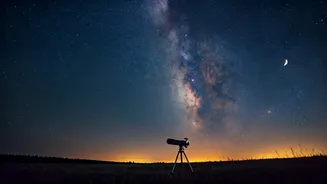
The moon is the brightest object in the night sky and a significant source of natural light pollution. A full moon can wash out all but the brightest stars and make it impossible to see the faint glow of the Milky Way or distant galaxies. For this reason, the best time for deep-sky stargazing is during the new moon phase or the few nights immediately before and after it. Many astronomy apps and calendars will show you the moon's phase and its rise and set times, allowing you to plan your sessions for when it is below the horizon. This simple step is crucial for anyone hoping to witness the full, breathtaking majesty of a star-filled sky.