







The Cosmic Haystack Problem
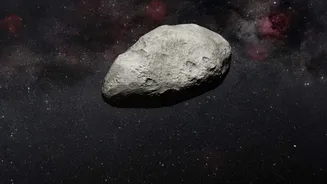
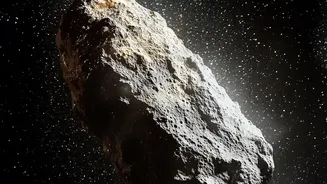
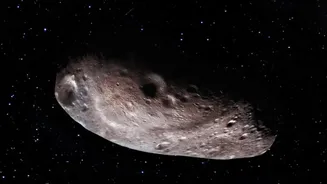
Finding a small asteroid hurtling towards Earth is a monumental challenge. Most are only a few metres across, dark, and moving incredibly fast against the blackness of space. They are too small and faint to be cataloged years in advance. In fact, most
are never detected at all. For a detection to occur, several factors must align perfectly: a powerful telescope must be looking at the right patch of sky at the right time, with clear weather on the ground. The object’s direction of approach is also critical; many are missed because they come from the direction of the Sun, lost in its blinding glare.
A Glimpse in the Night
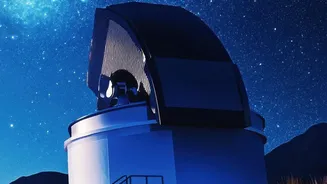
The hunt begins with wide-field survey telescopes, like those in the NASA-funded Catalina Sky Survey. These instruments repeatedly image large sections of the sky. Automated software then compares a new image with previous ones of the same area, searching for anything that has moved. The background stars remain static, so any moving point of light is flagged as a potential Near-Earth Object (NEO). This initial detection, often just a few data points, is the crucial first step. On September 6, 2026, the Mt. Lemmon Survey did just this, catching the first glimpse of a small asteroid, later named 2026 RW1, just over seven hours before it entered the atmosphere.
The Global Race to Confirm
A few dots of light are not enough to confirm an impact. Once a potential NEO is flagged, the data is sent to the Minor Planet Center (MPC), the worldwide clearinghouse for all asteroid and comet observations. This triggers an alert to a global network of astronomers, both professional and amateur. Observatories around the world race to find the object and take more measurements of its position. Each new observation helps refine the asteroid's trajectory. Systems like NASA’s Sentry and ESA’s Meerkat take this data and run complex calculations, testing thousands of potential paths to determine if one intersects with Earth. For asteroid 2024 BX1, which impacted over Germany in January 2024, observers reported over 200 measurements in the three hours between discovery and impact, confirming a 100% chance of collision.
From Warning to Fireball
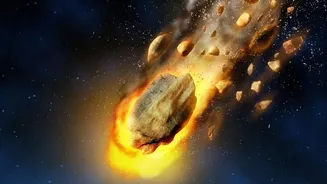
When an impact is confirmed, the focus shifts to predicting where and when. These last-minute asteroids are typically small, often only a metre or two in diameter, and pose no significant danger. They are expected to burn up harmlessly in the atmosphere, creating a spectacular fireball. The case of 2026 RW1 was the 13th time an asteroid impact had been successfully predicted. Scientists saw it as a valuable real-world test of planetary defense systems, proving their ability to detect, track, and predict the path of an incoming object in near real-time. While no meteorite recovery was possible from its impact over the Indian Ocean, fragments from 2024 BX1 were successfully found near Ribbeck, Germany, allowing for valuable scientific study.
The Next Generation of Guardians
While current systems are getting better at catching these small impactors, our ability to detect them is still limited. Future projects aim to dramatically improve our odds. The Vera C. Rubin Observatory, currently in its final stages of commissioning, will survey the entire Southern Hemisphere sky every few days, expecting to find millions of undiscovered asteroids. Its incredible sensitivity will help detect smaller and more distant objects than ever before. Meanwhile, NASA's NEO Surveyor, a space-based infrared telescope scheduled to launch around 2027, will be positioned to spot asteroids that are currently hidden by the Sun's glare. By sensing the heat they emit, it will be especially effective at finding dark asteroids that are difficult for ground-based optical telescopes to see. These next-generation observatories will be key to meeting the goal of finding the majority of potentially hazardous asteroids larger than 140 metres, giving us the early warning we would need to act.