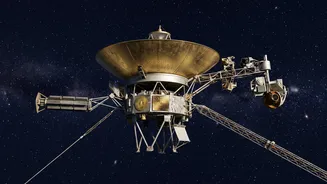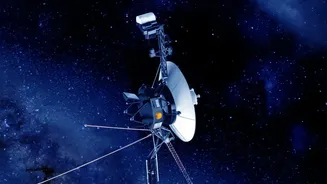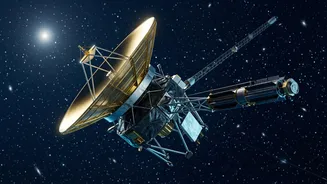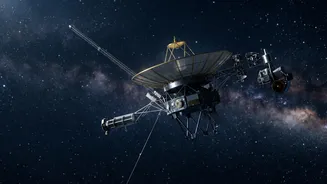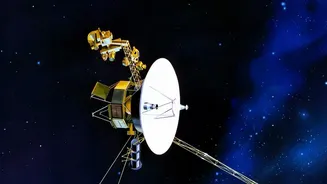



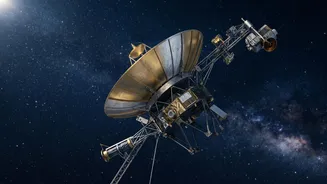
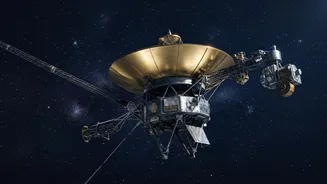
After nearly 49 years in the silent dark of deep space, a sudden quiet from Voyager 1 sent a wave of concern through NASA. Now, the signal is back. But what caused humanity’s most distant object to briefly stop phoning home?
A Sudden, Unsettling Silence
For two days in mid-October,
NASA's Deep Space Network—a global array of giant radio antennas—listened for Voyager 1 and heard nothing. Scheduled check-ins on October 18 and 19 were met with an unnerving silence from the probe, which is currently more than 25 billion kilometers from Earth. Then, on October 20, as abruptly as it vanished, Voyager 1’s signal returned. The spacecraft appeared to have resolved the issue on its own, before engineers on the ground could even send troubleshooting commands. Mission managers expressed relief but also a pressing need to understand what happened during the 48-hour outage.
The Ghost in the Machine
Engineers at NASA's Jet Propulsion Laboratory (JPL) are still investigating the root cause, but they have a significant clue. It appears the spacecraft's onboard fault protection system kicked in, automatically switching from its primary set of thrusters to a backup set. This automated response is designed to happen when the probe's computer detects a problem, putting it into a stable, low-activity 'safe mode' to await instructions. What remains a mystery is why the primary thrusters went offline in the first place. Mission managers noted this is the first time they've seen the spacecraft behave in this specific way, highlighting the unpredictable nature of operating such an old vehicle.
The Tyranny of Distance
Diagnosing and commanding Voyager 1 is a monumental exercise in patience. On November 18, 2026, the probe will reach a symbolic milestone: it will be one light-day away from Earth. This means a radio signal, traveling at the speed of light, takes a full 24 hours to reach the spacecraft. A response would take another 24 hours to come back. This 48-hour round-trip time for a single command and its confirmation underscores the immense challenge the JPL team faces. They are, in effect, performing remote surgery on a patient whose feedback takes two days to arrive.
A 49-Year_Old Marvel of Engineering
Launched in 1977, Voyager 1 was designed for a four_year mission to Jupiter and Saturn. It is now in its 49th year of operation, having become the first human_made object to enter interstellar space in 2012. Its longevity is a testament to its robust design. Power comes from radioisotope thermoelectric generators, which convert heat from decaying plutonium into electricity. While reliable, this power source is finite, losing about four watts of capacity each year. To prolong the mission, engineers have been methodically shutting down non_essential systems and recently performed a power_saving maneuver nicknamed the 'Big Bang' to keep its few remaining science instruments running. Without these efforts, another instrument might have been switched off as soon as summer 2027.
What Happens Now?
With communication re_established, the engineering team is carefully analyzing the data Voyager 1 has sent back to piece together the sequence of events during the outage. While the probe is stable on its backup thrusters, understanding the initial failure is critical for the long_term health of the mission. Age_related glitches are becoming more common. In recent years, engineers have overcome a memory fault that garbled data and revived dormant thrusters that had been unused for years. Each new anomaly presents a unique puzzle, solved from billions of kilometers away. The mission has long been in bonus time, and the team knows that one day, a signal may be lost for good. But for now, humanity’s farthest messenger continues its journey into the cosmos, its faint voice still reaching back to its creators.