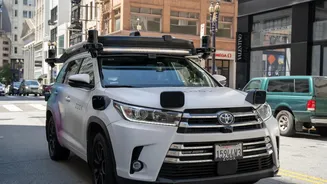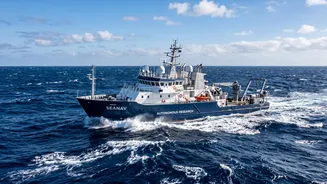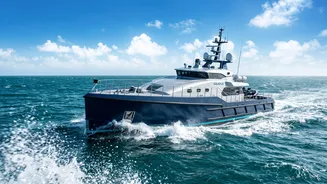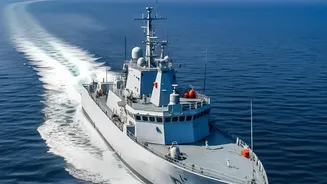



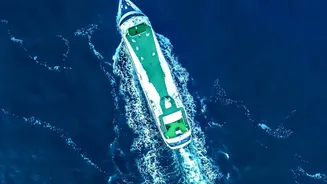
The age of self-driving ships is approaching, promising a revolution in global trade. But how do you teach a vessel the size of a skyscraper to navigate safely? Researchers at IIT Madras have developed a groundbreaking answer.
Meet SeaNav: A Digital Ocean in a Box
Researchers at the Indian
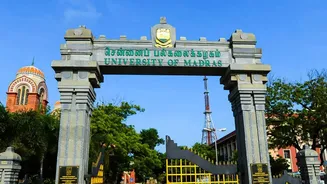
Institute of Technology Madras have unveiled 'SeaNav', a sophisticated platform designed to accelerate the development of autonomous maritime navigation. At its core, SeaNav is a 'digital twin' — a hyper-realistic virtual environment that mirrors the complexities of the open ocean. Instead of conducting risky and expensive real-world tests, engineers can use SeaNav to simulate everything from ocean waves and vessel traffic to complex sensor data in real time. Developed by the Department of Ocean Engineering, this innovation tackles one of the biggest hurdles for the global shipping industry, which is responsible for over 80% of world trade.
Why Virtual Testing is Crucial
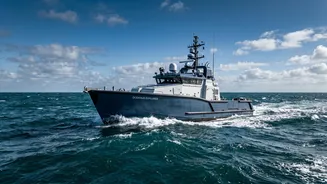
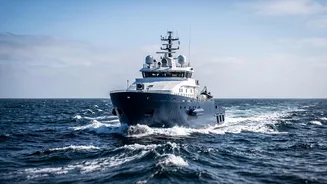
The dream of autonomous vessels promises safer and more efficient maritime transport, but testing these complex navigation algorithms in the real world is a logistical nightmare. It's expensive, potentially hazardous, and requires navigating a complex web of regulations. A single software bug could have catastrophic consequences. SeaNav provides a safe and scalable sandbox where these AI systems can be pushed to their limits. The platform, built on the Unity3D engine, can replicate challenging conditions like fog and rain, and even models the realistic limitations and noise from sensors, ensuring navigation systems are robust enough for the real world. The simulator was calibrated using a 320-meter benchmark tanker vessel to ensure its results closely mirror actual commercial shipping operations.
Inside the Technology
SeaNav is more than just a video game for ships. It's a powerful combination of digital twins, artificial intelligence, and advanced sensor fusion. According to Dr. Suresh Rajendran, Associate Professor at IIT Madras's Department of Ocean Engineering, the system creates an environment to train both autonomous systems and human operators safely before they are deployed. By integrating data from various simulated sensors like radar, lidar, and cameras, the platform helps developers fine-tune the AI that makes critical navigation decisions. It even features a Virtual Reality interface, allowing researchers and trainees to experience the simulation from a ship’s bridge, practicing everything from collision avoidance to docking in a major port.
The Challenge of Autonomy at Sea
Making a ship drive itself is vastly more complicated than a car. The maritime environment is unpredictable, with severe weather, long communication gaps with shore, and the sheer scale of the vessels posing unique challenges. Unlike roads, the 'rules' of the sea are less defined, and any autonomous system must be able to interact safely with human-piloted vessels. Furthermore, the industry faces significant cybersecurity risks, as a hacked autonomous ship could be used as a weapon or have its valuable cargo stolen. By providing a platform for rigorous testing, SeaNav helps address these deep-seated safety and reliability concerns, which are critical for gaining regulatory approval and insurance coverage.
A Boost for Indian Maritime Vision
The development of SeaNav is a significant step for India's maritime ambitions. The project aligns with national initiatives like the 'Sagarmala Programme' and 'Maritime India Vision 2030', which promote the use of digital technologies and the development of smart ports. Dr. Rajendran notes that the platform can directly help strengthen safety at major Indian ports like Chennai, Mumbai, Visakhapatnam, and Kochi by supporting the development of AI-assisted systems that reduce the risk of collisions and grounding. Beyond commercial shipping, SeaNav's multi-vessel simulation capabilities have potential applications in coastal surveillance, search-and rescue operations, and maritime defence, positioning India as a key innovator in this critical sector.