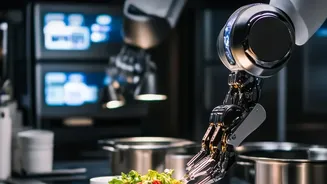







Ever found three recipes for the same dish and wondered which is best? Artificial intelligence promises to be your ultimate sous chef, but it has a dangerous habit of inventing facts. Here’s what’s going on and how to use it safely.
The AI Sous Chef: A Dream and a Delusion
Imagine asking your
phone to compare five different butter chicken recipes and tell you which one is the most authentic, the quickest, or the best for a novice cook. That’s the promise of using artificial intelligence in the kitchen. In theory, a large language model (LLM) like the ones powering popular chatbots can instantly read, parse, and synthesize vast amounts of information. It can look at one recipe that calls for marinating chicken for 30 minutes and another that says two hours and explain the difference in outcome. The problem is, these AI models can also confidently lie. This phenomenon, known as 'hallucination', is the model’s tendency to invent facts when it doesn’t know the answer. It might invent a cooking time, suggest a bizarre ingredient pairing, or cite a non-existent food blogger as its source. For a cook, this isn't just annoying; it can ruin dinner.
Why Your AI Confidently Makes Things Up
AI hallucinations happen because LLMs are not databases of facts; they are incredibly sophisticated pattern-matchers. Trained on a huge portion of the internet, their main goal is to predict the next most plausible word in a sentence. When you ask for a recipe, it assembles text that looks statistically similar to the millions of recipes it has seen. It doesn't 'know' that 45 minutes is the correct baking time for a cake; it just knows that '45 minutes' is a common phrase that follows 'bake until golden'. This makes it great at generating fluent, convincing text but poor at sticking to the truth. In a low-stakes context, this is a funny quirk. In the kitchen, where precise times, temperatures, and techniques are critical, a hallucinated instruction can lead to undercooked chicken or a cake that never sets. Researchers have found this is a major safety concern, especially when it comes to food preparation.
A Safer Method: Grounding AI in Reality
The good news is that developers are actively working on a fix. The most promising solution is a technique called Retrieval-Augmented Generation, or RAG. Think of it like giving the AI a specific stack of trusted cookbooks to work from instead of letting it roam the entire internet. A RAG-based system first retrieves information from a curated, verified knowledge base—like a database of tested recipes from a reputable source. Only then does it use the language model to generate an answer based solely on that retrieved information. It can't just invent a cooking time because the prompt forces it to cite its source. This 'grounding' dramatically reduces hallucinations and ensures the AI's output is based on real, tested methods. Several new AI recipe and cooking apps are built on this safer architecture, aiming to provide a more reliable kitchen assistant.
How to Use AI for Recipes Today
While you wait for perfectly grounded AI, you can still use today’s tools to compare recipes—you just have to be smart about it. Instead of asking a general chatbot to create a new recipe, use it to analyze existing ones. Provide the AI with the full text of two or three recipes you've found and ask specific questions. For example: 'Based on these three recipes, list the differences in oven temperature and explain the likely effect on the final texture'. Or, 'Summarize the ingredients common to all three recipes and those unique to each'. This forces the AI into a role of comparison rather than creation, reducing the chance of it inventing details. Always cross-reference crucial information like cooking times and temperatures for meat against trusted sources like the USDA guidelines. And remember, AI can't taste, so your own senses remain the most important tool in the kitchen.