





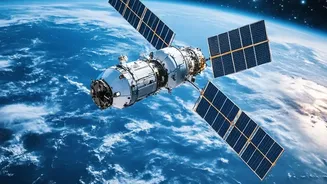
The Drag Dilemma in Low Orbit
Low-Earth Orbit (LEO) is the busiest orbital highway around our planet, home to thousands of satellites that provide everything from internet service to Earth imagery. But staying there is a constant battle. Even hundreds of kilometers up, there's a trace
amount of atmosphere that creates drag on a satellite, slowing it down and causing its orbit to decay. To fight this, satellites must fire thrusters, but they can only carry a finite amount of propellant. Once the fuel runs out, the satellite's mission is effectively over, and it eventually falls back to Earth. This fundamental limitation restricts how long satellites can operate and at what altitudes. The lower you go, the thicker the air and the shorter the mission, unless you have a massive fuel tank.
Introducing Air-Breathing Propulsion
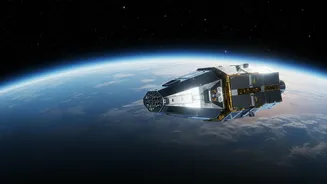
Air-Breathing Electric Propulsion (ABEP) flips the problem of drag on its head. Instead of carrying propellant, an ABEP-equipped satellite uses a special intake to scoop up the sparse atmospheric molecules it encounters as it speeds through orbit. These captured particles—mostly nitrogen and oxygen—are then ionized (given an electrical charge) inside a thruster. Using power from solar panels, electric and magnetic fields accelerate these ions and shoot them out the back at high velocity, generating thrust. This thrust is small, but it's designed to be just enough to continuously counteract the force of atmospheric drag, allowing the satellite to maintain its altitude indefinitely without using a single drop of propellant brought from Earth.
How 'Fuel-Free' Redefines Space Missions
The term 'fuel-free' is revolutionary. While ABEP systems still need electrical power, being free from onboard propellant changes the economics and capabilities of space missions. A satellite's operational life is no longer limited by its fuel tank but by the durability of its electronic components, potentially extending missions from a few years to a decade or more. This also dramatically reduces launch weight and cost, as bulky propellant tanks are no longer needed. The European Space Agency's (ESA) GOCE satellite demonstrated the challenge when its highly successful mission ended after its 40kg of xenon propellant ran out. An air-breathing system would have allowed it to continue its work.
From Theory to Reality
This technology is not just science fiction. The European Space Agency has been a pioneer, successfully test-firing a full ABEP system in a vacuum chamber that simulated the conditions of a 200 km altitude orbit. The ground test proved that a specially designed intake could collect high-velocity particles and channel them into a thruster for ionization and acceleration. These efforts, part of projects like AETHER and in collaboration with companies like Sitael, are advancing the technology's readiness for an eventual in-orbit demonstration. Research is also active in Japan, the US, and the UK, with various groups developing different components, from the intake scoops to the thruster technology itself, aiming to make these systems robust and efficient.
A More Sustainable Future in Space
The implications of ABEP extend beyond just longer missions. Operating satellites in Very Low Earth Orbit (VLEO), below 300 km, offers huge advantages like higher-resolution imaging and lower-latency communications. ABEP makes long-term VLEO missions feasible for the first time. Furthermore, it promotes a more sustainable use of space. Since these satellites don't rely on finite fuel, there's less risk of creating more space debris from defunct spacecraft. When a mission is over, the propulsion can be switched off, and the natural atmospheric drag will cause the satellite to de-orbit and burn up harmlessly.
Hurdles on the Horizon
Despite the promise, challenges remain before fleets of air-breathing satellites populate the sky. The technology is still maturing, and designing an intake that is efficient enough to collect hyper-rarefied air at over 7 km/s is a major engineering feat. The thrust generated is very low, making the system suitable only for drag compensation, not for rapid orbital maneuvers. Furthermore, the atomic oxygen in VLEO is highly corrosive, presenting materials science challenges for building long-lasting satellites. Successful in-orbit demonstrations will be the next crucial step to prove the technology's viability in the harsh environment of space. Following recent successful design reviews in 2026, projects are now moving toward building and testing hardware prototypes.