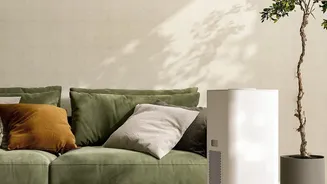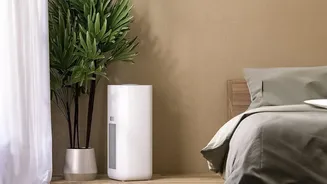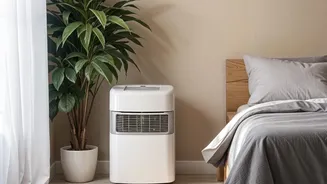








The desire for clean indoor air has made houseplants a popular, 'natural' solution. But how do they stack up against air purifiers? Understanding the real-world impact of both is key to breathing easier at home.
The Green Solution Myth
The idea that houseplants are powerful air
purifiers is a persistent one, largely born from a 1989 NASA study. This research showed that plants in a small, sealed chamber could remove volatile organic compounds (VOCs) like benzene and formaldehyde from the air. The study was designed to explore life support systems for space stations, not for the average living room. As a result, the findings have been widely misinterpreted. In a typical home, which has constant air exchange with the outdoors and numerous sources of pollution, the real-world air-cleaning effect of a few plants is negligible.
The Mechanical Alternative
Air purifiers are the technological answer to indoor air pollution. These devices work by pulling air through a series of filters to capture airborne contaminants. Most effective models use a True HEPA (High-Efficiency Particulate Air) filter, which is designed to capture 99.97% of particles as small as 0.3 microns. This includes common irritants like dust, pollen, pet dander, and mould spores. Many purifiers also include an activated carbon filter, which is effective at trapping odours and the gaseous VOCs that the NASA study focused on, offering a much more comprehensive and rapid cleaning solution.
Decoding Clean Air Delivery Rate (CADR)
To understand an air purifier's effectiveness, you need to know its Clean Air Delivery Rate, or CADR. Developed by the Association of Home Appliance Manufacturers (AHAM), CADR measures the volume of filtered air a purifier can produce, usually in cubic feet per minute (CFM) or cubic metres per hour (m³/h). It provides a standardized way to compare how quickly different models can clean a room. The rating is typically broken down into three categories for particles of different sizes: smoke (the smallest), dust (medium), and pollen (the largest). A higher CADR number means the purifier can clean the air in a room faster and more efficiently.
Plants vs. Purifiers: A Numbers Game
When you apply the CADR metric to houseplants, the comparison becomes stark. Research reviews have calculated that a typical houseplant has a CADR of less than 1. In contrast, an average air purifier has a CADR of 100 or more. This means a mechanical purifier cleans the air over 100 times faster. To match the air-cleaning performance of a single, modest air purifier, studies estimate you would need an impractically large number of plants—somewhere between 10 and 1,000 plants per square metre of floor space. For a small bedroom, this could mean needing over 65 plants, and for an average home, it could be thousands. The idea of creating an indoor jungle dense enough to purify air is simply not feasible for most people.
The Right Role for Each
This doesn't mean you should get rid of your plants. While they fail as significant air purifiers, houseplants offer other proven wellness benefits. Studies show that being around indoor plants can reduce stress, lower blood pressure, and improve concentration and productivity. They also add humidity to the air and bring aesthetic beauty to a space. The key is to assign the right job to the right tool. An air purifier's job is to effectively remove airborne pollutants. A houseplant's role is to enhance your well being and beautify your home. They are not interchangeable.