


Cosmic Time Capsules
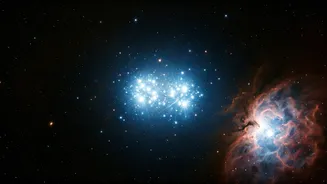
Globular clusters are some of the most ancient objects in the universe. These are tightly packed, spherical collections of hundreds of thousands, or even millions, of stars, all bound together by gravity. Most are believed to be over 10 billion years
old, meaning they formed in the very early days of the cosmos, not long after the Big Bang. Because of their age, astronomers have long treated them as cosmic time capsules. The thinking was that the stars within a single cluster all formed at roughly the same time from the same cloud of gas. This made them seem like perfect, simple laboratories for studying the conditions of the early universe. The prevailing theory suggested that once they formed, they were done, with no new generations of stars being born.
The Expected Story Crumbles
For years, the standard model of cosmology held that globular clusters were straightforward structures. They were thought to consist of a single, ancient population of stars and, unlike entire galaxies, they showed little to no evidence of containing dark matter—the mysterious, invisible substance that makes up most of the universe's mass. This lack of dark matter made them fundamentally different from even the smallest dwarf galaxies. However, recent observations, particularly from the Hubble and James Webb Space Telescopes (JWST), have begun to complicate this tidy picture. The powerful infrared vision of these telescopes allows astronomers to peer through cosmic dust and into the crowded hearts of these clusters with unprecedented clarity.
A Cluster of Surprises
One prominent example is a system called Terzan 5, long classified as a globular cluster in our own Milky Way galaxy. Scientists expected to find one population of old stars. Instead, new data has revealed a far more complex history. Observations have confirmed not just two, but evidence for four distinct generations of stars formed at widely different times: 12.5 billion, 4.7 billion, 3.8 billion, and even a relatively recent 2.5 billion years ago. This discovery shatters the idea that these are static, one-and-done systems. A true globular cluster is expected to have only one ancient star population. Finding multiple bursts of star formation over billions of years suggests Terzan 5 may not be a globular cluster at all, but perhaps the remnant of a dwarf galaxy that was cannibalized by the Milky Way.
Rewriting the Rules of Formation
The puzzles don't stop there. Other recent discoveries from JWST have identified what appear to be young globular clusters forming in a galaxy just 460 million years after the Big Bang. These 'Cosmic Gems' are incredibly massive and have formed much earlier and faster than many models predicted. At the same time, other research points to protoclusters—infant galaxy clusters—in the early universe that are five times hotter than expected, forcing another rethink of how these massive structures assemble. Some studies have even proposed that certain ancient clusters could be older than the commonly accepted age of the universe itself, suggesting our entire cosmological model might need revision. These findings challenge the timeline of galaxy and star formation, indicating that the early universe was far more active and capable of building large, complex structures much faster than previously thought.
The Search for Answers Continues
These discoveries are sending theorists back to the drawing board. If objects like Terzan 5 are actually fossil fragments of ancient galaxies, it changes our understanding of how the Milky Way was built. Meanwhile, findings of extremely massive and hot clusters in the early universe are pushing the limits of our cosmological models. Scientists are now using detailed computer simulations to trace the universe's 13.8-billion-year history and have found multiple possible pathways for how these clusters could have been created. Each new observation from telescopes like JWST provides a crucial piece of the puzzle. The picture emerging is one of a more dynamic and complex early cosmos, where the lines between star clusters and small galaxies are blurrier than ever imagined.