




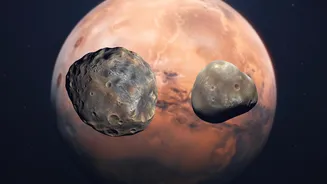


Humanity's quest to understand the solar system took a giant leap forward on October 20, 2026, with the launch of Japan's Martian Moons eXploration (MMX) mission. This ambitious probe is now on its way to one of the most mysterious objects in our celestial
neighbourhood: Phobos, the larger of Mars's two moons.
An Ambitious Interplanetary Heist
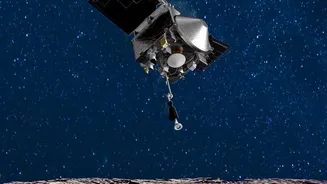
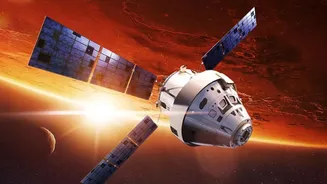
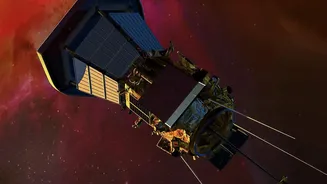
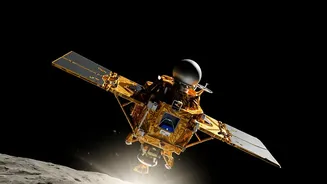
The MMX mission, led by the Japan Aerospace Exploration Agency (JAXA), is no ordinary space probe. It's a highly sophisticated robotic explorer on a five-year round-trip journey to the Red Planet's doorstep. After arriving in the Martian system in August 2027, the spacecraft will spend about three years meticulously studying Mars and its two moons, Phobos and Deimos. The main event will see MMX touch down on the surface of Phobos, not once but possibly twice, to collect at least 10 grams of rock and dust. This precious cargo will then be sealed in a capsule and sent on a long voyage back to Earth, with a planned landing in Australia in 2031. It marks the world's first attempt to bring back a physical sample from the Martian system.
Why Phobos Holds the Key
Phobos and its smaller sibling, Deimos, are among the solar system's great enigmas. Scientists are deeply divided on their origins, with two primary theories competing for attention. One hypothesis suggests they are captured asteroids, wanderers from the early solar system that strayed too close to Mars and were snared by its gravity. If true, their composition could tell us about the building blocks of planets and how water and organic materials were delivered to worlds like Earth. The second theory posits that the moons were formed from debris blasted into orbit by a colossal impact on a young Mars, much like how our own Moon is thought to have been created. By analysing samples directly, scientists can finally solve this puzzle. The material from Phobos could either be pristine asteroid matter or ancient Martian crust, each telling a profoundly different story about the evolution of our corner of the cosmos.
A Complex and Collaborative Mission
Pulling off such a complex mission is a global effort. While JAXA is leading the charge, MMX involves significant international collaboration with contributions from NASA, the European Space Agency (ESA), and the French and German space agencies (CNES and DLR). For its part, NASA has provided a key science instrument, a gamma-ray and neutron spectrometer called MEGANE, which will help determine the chemical composition of Phobos. The German and French agencies have built a small, 25-kilogram rover named Idefix that MMX will deploy onto the moon's surface. This rover will spend about 100 days exploring the terrain, analysing the surface, and helping mission planners identify the best spot for the main spacecraft to land and collect its samples. The low gravity on Phobos means the rover will be 'dropped' from a height of about 50 meters, bouncing to a stop before beginning its work.
The Long Journey Home
The MMX mission builds on the incredible success of JAXA's previous sample-return missions, Hayabusa and Hayabusa2, which brought back material from asteroids. However, MMX is far more complex, requiring a spacecraft to enter and then escape the gravitational pull of an entire planet. After its launch, the probe will spend about a year travelling to Mars. Following its extensive survey and sampling operations around Phobos and a series of flybys of Deimos, the spacecraft will begin its return journey in 2030. The return module will jettison the sample capsule for a fiery reentry through Earth's atmosphere before it parachutes to a safe landing in the Australian desert. Once recovered, the tiny specks of a Martian moon will be analysed in laboratories around the world, promising to unlock secrets about the history of Mars and the formation of our solar system.