








The Planet's Watchful Eye
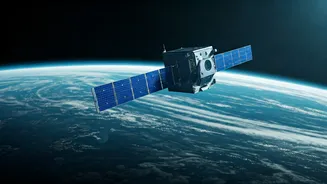
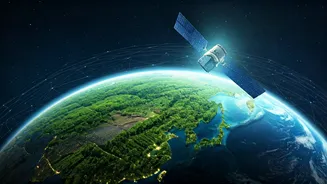
The most immediate contribution of space to sustainability is perspective. Hundreds of Earth-observation satellites orbit our planet, acting as a planetary-scale health monitoring system. These aren't just for taking pretty pictures; they are sophisticated
instruments tracking the vital signs of our world in unprecedented detail. Satellites from agencies like NASA, the European Space Agency (ESA), and our own ISRO provide crucial, unbiased data on climate change. They measure rising sea levels with millimetre precision, monitor the retreat of glaciers, and track greenhouse gas concentrations in the atmosphere. For India, this technology is already a game-changer. ISRO’s fleet of satellites, like the Cartosat and Resourcesat series, provides invaluable data for managing agriculture, predicting crop yields, and monitoring water resources in our rivers and reservoirs. By identifying illegal deforestation in remote jungles or tracking the path of an oil spill in the ocean, these eyes in the sky empower governments and organisations to act swiftly to protect fragile ecosystems. This constant stream of data is the bedrock of modern environmental science and policy, turning abstract threats into measurable, manageable problems.
Lessons in Ultimate Recycling
Living in space is the ultimate exercise in resource conservation. On the International Space Station (ISS), every drop of water, every puff of air, and every gram of waste is precious. Astronauts rely on advanced closed-loop life support systems that recycle nearly 98% of the water they use—from sweat to urine—back into pure drinking water. Air is scrubbed of carbon dioxide, and experiments are underway to convert waste into nutrients for growing plants. This technology, born of necessity in a hostile environment, holds powerful lessons for Earth. As our cities grow and resources become scarcer, the principles of a circular economy—where waste is eliminated and resources are continually reused—are becoming essential. The engineering breakthroughs required to keep humans alive in space can directly inform the design of hyper-efficient water purification plants, air filtration systems for buildings, and innovative waste-to-resource facilities on the ground. Space forces us to perfect sustainability on a small scale, creating a blueprint for us to follow on a planetary one.
Manufacturing with Zero Impact
Some of Earth’s most vital industries are also its most polluting. Manufacturing semiconductors, fibre-optic cables, and complex pharmaceuticals often requires vast amounts of energy and water, and can produce toxic by-products. But what if we could move some of these processes off-planet? This is the promise of in-space manufacturing. In the microgravity environment of orbit, crystals grow more perfectly, alloys mix in unique ways, and 3D printing of biological tissues is possible without the deforming pull of gravity. Companies are already experimenting with manufacturing high-value products in space that are impossible to create with the same quality on Earth. The long-term vision is revolutionary. By shifting certain high-impact industrial activities into orbit, we could significantly reduce the environmental and energy burden on our terrestrial ecosystems. Power for these orbital factories would come from abundant, unfiltered sunlight. While we are in the very early days of this shift, it represents a fundamental rethinking of industry, aiming to preserve Earth as a place for living, not just for making things.
Harnessing the Sun’s Raw Power
The most ambitious concept linking space and sustainability is space-based solar power (SBSP). The idea is simple in principle: place massive solar panels in orbit where they can soak up the sun’s energy 24/7, unhindered by clouds or nighttime. This energy is then converted into microwaves and beamed wirelessly to receiving stations on Earth, which convert it back into electricity for the grid. A single SBSP system could potentially provide a constant, massive supply of clean energy, dwarfing the output of terrestrial solar or wind farms. While the engineering and economic challenges are immense, nations like China, Japan, and the US are actively researching the technology. For a rapidly growing economy like India, with its soaring energy demands, a future powered by SBSP could mean energy independence without the carbon footprint. It remains a long-term goal, but it illustrates the ultimate potential of using space not just to monitor our world, but to power it cleanly and perpetually.