






The Journey Begins on the Pavement
Every year, Indian cities face the deluge of the monsoon. Along with providing relief from the heat, the rains perform a massive, unintended cleaning service. Rainwater flows over roads, pavements, and open spaces, picking up everything in its path. Chief
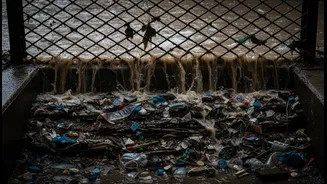
among this debris is plastic waste. India generates millions of tonnes of plastic waste annually, and a significant portion ends up improperly disposed of on our streets and in open drains. When the downpour begins, this discarded plastic is the first thing to move. Carried by the current of the high rain runoff, it is channelled into the city's stormwater drainage system, starting a journey from the public eye into our water networks.
Sun and Rain: A Toxic Combination
Plastic waste doesn't just float along; it changes. While lying on the streets, plastic is exposed to sunlight. The sun's ultraviolet (UV) radiation makes the plastic brittle, breaking it down into smaller and smaller pieces. This process, called photodegradation, combined with the physical abrasion from wind and rain, creates secondary microplastics—fragments less than 5 millimetres in size. But the breakdown doesn't stop there. These microplastics can fragment further into nanoplastics, particles so small they are invisible to the naked eye. Beyond just physical fragmentation, this process also causes chemical leaching. Additives used during plastic manufacturing, such as phthalates and bisphenol A (BPA), are not chemically bound to the plastic and can seep out into the environment.
A Chemical Cocktail in the Gutter
As the rainwater runoff carries these plastic particles, it becomes more than just water and debris; it transforms into a kind of chemical soup. The runoff now contains a mix of microplastics, nanoplastics, and the chemicals that have leached from them. To make matters worse, these tiny plastic particles act like sponges for other environmental pollutants. Harmful substances already present in the urban environment, such as heavy metals from traffic, pesticides from gardens, and other industrial chemicals, can attach themselves to the surface of microplastics. So, the stormwater rushing through our drains during a monsoon is not just carrying plastic but a concentrated dose of associated toxins. Studies in India have shown a dramatic increase in microplastic concentrations in water bodies immediately following the monsoon, confirming that the rains effectively flush these pollutants into the ecosystem.
From City Drains to Water Reservoirs
The journey of this polluted runoff doesn't end in the local drain. In most cities, stormwater systems are designed to discharge into the nearest water body. This means the microplastic and chemical-laden water flows directly into the rivers, lakes, and reservoirs that are often the primary sources for our municipal drinking water. Rivers in major Indian metropolitan areas like Mumbai are already choked with plastic, which exacerbates flooding by blocking drainage and continuously contaminates the water. The Mithi River, for example, is a stark reminder of how a natural waterway can become a conduit for plastic pollution, carrying it towards the sea but also impacting the entire local water table.
The Challenge at the Treatment Plant
The final line of defence is our water treatment plants. These facilities are effective at removing larger contaminants, sediment, and bacteria. However, they were not designed to deal with the modern challenge of microscopic and nanoscopic plastic particles. While a significant portion of microplastics can be filtered out, the smallest particles, particularly nanoplastics, can pass through conventional filtration systems. The dissolved chemicals that have leached from the plastics pose a similar challenge. As a result, trace amounts of these contaminants can potentially make it into the treated water that is piped to our homes. Studies have now detected nanoplastics in both tap and bottled water around the world, raising questions about the long-term safety of our drinking water sources.