



A Tale of Two Cosmic Clocks
On Earth, our sense of time is governed by two simple cycles: the planet spins on its axis once every 24 hours (a day), and it completes one orbit around the Sun every 365.25 days (a year). This rhythm is so fundamental to our lives that it’s hard to imagine
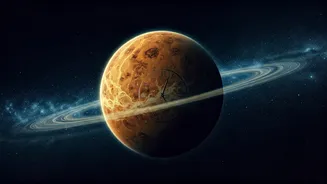
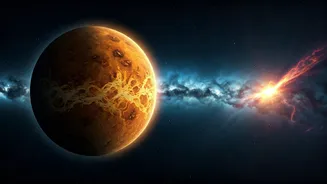
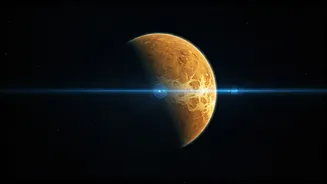
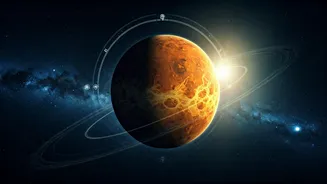
it working any other way. But on Venus, the clocks are completely out of sync. Venus takes approximately 225 Earth days to complete one full orbit around the Sun. That’s its year. However, it rotates on its axis incredibly slowly, taking a staggering 243 Earth days to complete just one full spin. So, if you were to measure a 'day' by a single full rotation, that day on Venus is 18 Earth days longer than its entire year. This makes Venus unique in our solar system as the only planet with a day that outlasts its year.
Defining What a 'Day' Really Means
To fully grasp this cosmic oddity, we need to distinguish between two types of days. The first is a 'sidereal day', which is the time it takes for a planet to complete a single 360-degree rotation on its axis relative to the distant stars. For Venus, this is 243 Earth days. This is the measurement that is longer than its year. The second type is a 'solar day', which is the time it takes for the Sun to appear in the same position in the sky—what we typically think of as the period from one sunrise to the next. Because Venus rotates backwards (more on that below) while also orbiting the Sun, its solar day is actually shorter than its sidereal day, clocking in at around 117 Earth days. While that’s shorter than a Venusian year, a day-night cycle that lasts nearly four Earth months is still an incredibly long and alien concept.
Spinning the Wrong Way
Adding to the strangeness is Venus’s direction of rotation. Nearly every planet in our solar system, including Earth, spins on its axis in a counter-clockwise direction. This is called prograde motion. Venus, however, spins clockwise. This is known as retrograde rotation. If you could stand on the surface of Venus (and survive its hellish conditions), you would see the Sun rise in the west and set in the east, the complete opposite of what we experience on Earth. This backward spin is a crucial piece of the puzzle. It works against the planet's orbital motion, which complicates the length of its solar day and contributes to its bizarre timekeeping. Only one other planet, Uranus, which is tilted on its side, shares this peculiar trait.
The Prime Suspect: A Heavy Atmosphere
So, why does Venus spin so slowly and backwards? For a long time, scientists theorised that a massive collision with an asteroid or another large celestial body in its distant past knocked it off-kilter and slowed its rotation. While this is still a possibility, a more prominent theory now focuses on its incredibly thick atmosphere. Venus's atmosphere is about 90 times denser than Earth's, creating immense surface pressure. This heavy, churning sea of gas is thought to create powerful atmospheric tides, driven by the Sun's gravitational pull. Over billions of years, this atmospheric 'drag' could have acted like a powerful brake, slowing the planet's rotation to its current crawl and may have even been strong enough to reverse its original direction of spin entirely. The planet essentially got caught in a gravitational tug-of-war between its own solid body and its thick, soupy air.
A World of Blistering Extremes
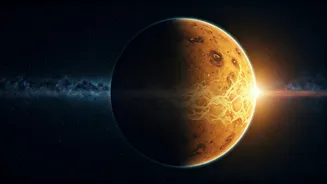
This ultra-slow day-night cycle has profound consequences. With a solar day lasting 117 Earth days, the side of Venus facing the Sun bakes for months on end. Its dense carbon dioxide atmosphere creates a runaway greenhouse effect, trapping heat and raising surface temperatures to an average of 465°C—hot enough to melt lead. This temperature remains relatively constant across the entire planet, even on the side shrouded in a months-long night. The thick clouds of sulfuric acid don't allow much heat to escape, so there's little relief. The planet becomes a global oven, with no cool nights to offer a reprieve from the relentless, crushing heat. The slow rotation means any notion of a temperate dawn or dusk simply doesn't exist.