





A Frigid Zone of Icy Relics
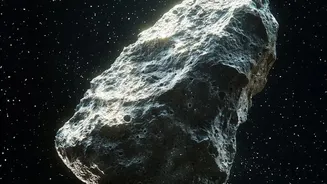
The Kuiper Belt is a vast, doughnut-shaped region of space beyond the orbit of Neptune, often called the solar system’s ‘attic’. It's a frigid, dark realm populated by hundreds of thousands of icy bodies that are leftovers from the formation of our solar system some
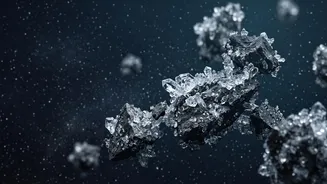
4.5 billion years ago. Because they are so far from the Sun and have remained largely unchanged, these objects are like time capsules, holding secrets about the primordial environment from which the planets were born. Until now, studying these objects directly has been incredibly difficult due to their immense distance and faintness. However, dust particles are constantly being chipped off these bodies by collisions and slowly spiral toward the inner solar system, with some eventually reaching Earth.
Cosmic Dust Detectives at Work
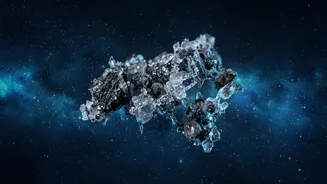
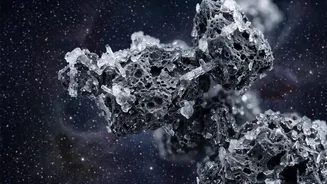
So, how did scientists capture these messengers from the solar system's edge? NASA used high-altitude research aircraft flying in the stratosphere, far above the weather and terrestrial dust, to collect interplanetary dust particles. A team led by Lindsay Keller of NASA's Johnson Space Center then analysed these microscopic grains. They identified 12 specific particles, each just 10 to 30 micrometres wide, as originating from the Kuiper Belt. The giveaway was their 'travel scars'; the grains had an extremely high number of radiation tracks, damage left by solar energetic particles during a very long journey through space. This long exposure time could only be explained by a trip from the distant outer solar system.
Water Locked Inside Minerals
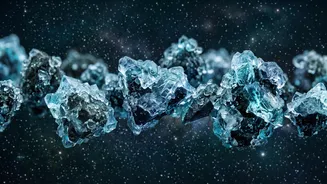
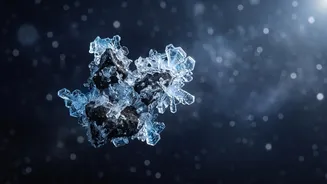
The most exciting discovery came when the team examined the composition of these dust grains. They were found to be rich in clay-like minerals, such as saponite and serpentine. These types of minerals, known as hydrated minerals, only form through the interaction of rock with liquid water. This means that billions of years ago, liquid water must have existed inside the parent bodies from which this dust originated. While the Kuiper Belt is frozen today, scientists believe that heat from radioactive decay within these ancient objects could have been sufficient to melt interior ice, creating subsurface liquid water. The water itself is long gone, but its chemical signature was perfectly preserved in the minerals it helped create.
A Separate, Primordial Water Reservoir
This wasn't just any water. By analysing the isotopes of oxygen locked in the clay minerals, the researchers found it was unusually rich in 'heavy' oxygen isotopes (Oxygen-17 and Oxygen-18). This isotopic fingerprint is significantly different from the water found in our oceans or in meteorites that originated closer to the Sun. The finding provides compelling evidence for a long-theorised but unproven idea: that there was a vast, separate reservoir of heavy water in the outer solar system. This reservoir remained largely isolated, preserving a pristine sample of the early solar system's chemistry, distinct from the more mixed and processed materials found in the inner solar system.
Clues to the Origin of Earth's Oceans
This discovery has profound implications for understanding our own planet. Scientists have long debated how Earth, which formed in a hot, dry region of the solar system, got its abundant water. One leading theory is that it was delivered by comets and asteroids from the outer solar system crashing into a young Earth. These dust grains, with their preserved signature of ancient water, represent some of the most direct evidence yet supporting the idea that water-rich materials were available in the icy depths of the solar system. By studying the unique chemical makeup of this primordial water, we can get closer to understanding the ingredients that were available for forming not just our oceans, but potentially for seeding life itself.