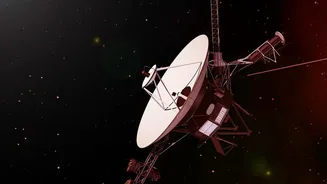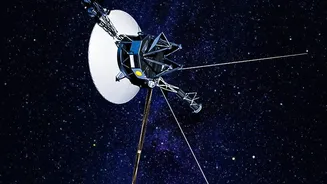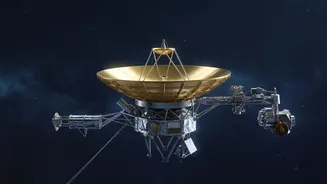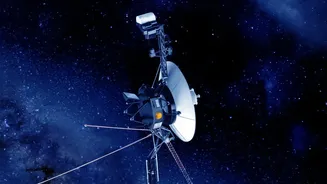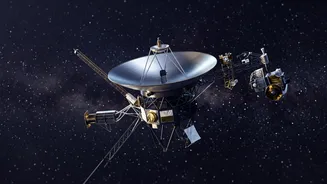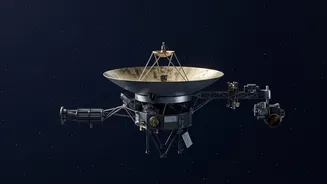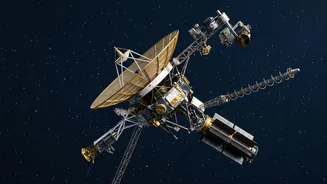



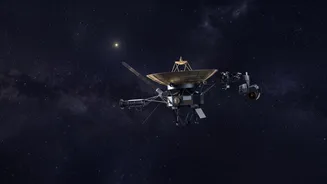
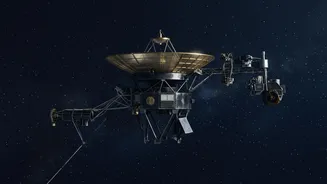
On November 18, 2026, humanity’s farthest emissary, the Voyager 1 spacecraft, will achieve a staggering milestone. It will be one light-day from Earth—a distance so vast that it fundamentally alters how we communicate with it.
A Milestone Measured in Light
Imagine a distance so great
that light itself, the fastest thing in the universe, takes a full 24 hours to cross it. That’s a light-day, and it’s the milestone Voyager 1 will reach on November 18. Launched in 1977, the probe has travelled for nearly five decades to reach this point, which translates to roughly 25.9 billion kilometres. For perspective, light from the Sun reaches Earth in about eight minutes; a signal to Voyager 1 will take an entire day. This isn't just a record; it's a profound demonstration of the scale of interstellar space and the incredible endurance of a machine built with 1970s technology. The probe continues to speed away from us at over 60,000 km/h, ensuring this is a milestone it will never cross back over.
The Ultimate Long-Distance Call
The growing distance directly translates into a growing communication lag. When Voyager 1 reaches one light-day away, the delay becomes stark: a 48-hour round trip. A command sent from an engineer at NASA's Jet Propulsion Laboratory (JPL) will travel for 24 hours at the speed of light to reach the probe. Then, the confirmation signal, or 'I got your message,' will take another 24 hours to travel back to Earth. This two-day wait to confirm a single command makes operating the spacecraft an exercise in extreme patience and foresight. Every instruction must be meticulously planned, as troubleshooting in near real-time is impossible. It is the longest and loneliest communication line ever maintained by humanity.
More Than Just Distance
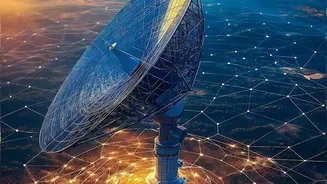
The challenge isn't just the time delay; it's also the signal's weakness. Voyager 1's transmitter has the power of a refrigerator light bulb, about 23 watts. By the time its signal travels across 25.9 billion kilometres, it has spread out so much that it arrives at Earth as a whisper, a hundred billion billionth of a watt. Capturing this incredibly faint message requires the world's most sensitive listening arrays: NASA’s Deep Space Network (DSN). The DSN uses massive 70-meter radio dishes in California, Spain, and Australia, spaced out so that one of them can always be pointed at the spacecraft as the Earth rotates. Without these giant ears, Voyager’s whispers from interstellar space would be lost forever in the cosmic background noise.
A 1970s Legend Still Talking
The fact that we can communicate with Voyager 1 at all is a miracle of engineering. This aging probe has survived numerous close calls. As recently as late 2023, it began sending back garbled data due to a corrupted memory chip. Over several months, engineers on Earth diagnosed the problem and, in an astonishing feat of long distance repair, transmitted a software fix that brought the probe back to full health by mid‑2024. In October 2026, it went silent for 48 hours before its autonomous fault protection systems switched to a backup set of thrusters and re‑established contact, a new problem that highlighted the mission's 'expect the unexpected' phase. Its plutonium power source is also fading, losing about four watts of power each year, forcing engineers to make difficult decisions about which instruments to shut down to conserve energy.