






Why All Eyes Are on Europa
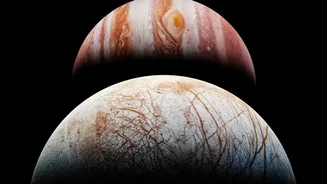
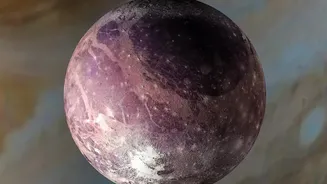
For decades, scientists have been captivated by Europa, the fourth-largest of Jupiter's many moons. Beneath a thick, frozen crust, strong evidence suggests the existence of a global ocean of liquid saltwater. In fact, this hidden ocean is estimated to
contain more than twice the amount of water found in all of Earth's oceans combined. Where there is liquid water, there is the potential for life as we know it. Scientists believe Europa might possess the three key ingredients necessary: liquid water, essential chemical elements, and a source of energy. While sunlight can't pierce the ice shell, which could be up to 30 kilometres thick, heat from the moon's interior could create hydrothermal vents on the ocean floor, similar to those on Earth that teem with life. This makes Europa one of the most compelling targets in our solar system in the search for habitable environments beyond our own planet.
Meet the Clipper: A Robotic Explorer
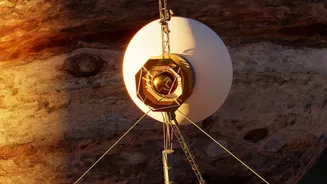
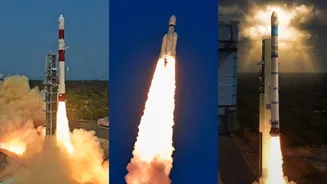
To investigate this tantalizing world, NASA has designed and launched the Europa Clipper, the largest interplanetary spacecraft the agency has ever built. Spanning over 30 meters with its solar arrays deployed—roughly the length of a basketball court—it is a marvel of engineering. The spacecraft launched aboard a SpaceX Falcon Heavy rocket on October 14, 2024, beginning a long and complex journey to the outer solar system. Due to the immense distance, the Clipper won't arrive at Jupiter until April 2030. Its mission is not to land, but to conduct a series of close flybys, a total of 49 passes over the moon. This strategy allows it to gather detailed data while minimizing its exposure to Jupiter's intense radiation, which could damage its sensitive instruments.
A Toolkit for Astrobiology
The Europa Clipper is equipped with a suite of nine advanced scientific instruments designed to act as a remote detective. These tools will work together to paint a comprehensive picture of the moon. An ice-penetrating radar, called REASON, will probe the icy shell to determine its thickness and search for pockets of water within it. Spectrometers will analyze the composition of the surface to identify the strange reddish-brown material seen in previous images and understand what chemicals are present. The mission will also use a magnetometer to measure the magnetic field around Europa, which can help confirm the depth and saltiness of the subsurface ocean. Cameras will map nearly 90 percent of the moon's surface in unprecedented high resolution, looking for recent geological activity or potential eruption sites.
Searching for Signs, Not Creatures
It's important to clarify what the Clipper is looking for. The mission's primary goal is not to find life itself, but to determine if Europa is habitable—if it has the right conditions to support life. The spacecraft will hunt for biosignatures, or chemical signs that could indicate biological processes. One of the most exciting possibilities is flying through a plume of water vapor venting from the ocean into space. Instruments like the SUrface Dust Analyzer (SUDA) and a mass spectrometer (MASPEX) are designed to sample this material directly, analyzing its chemical makeup for clues about the ocean below without ever needing to land or drill through the ice. Finding complex organic molecules or evidence of chemical imbalances could be a monumental discovery in the field of astrobiology.
The Long Road Ahead
The journey to Jupiter is a marathon, not a sprint. The Europa Clipper is currently on a 1.8-billion-mile trajectory. To get there, it will perform a series of gravity assists—using the gravitational pull of planets to gain speed. It is scheduled for a flyby of Mars in March 2025 and will swing by Earth in December 2026 for a final boost. Once it arrives in the Jovian system in 2030, it will spend about a year adjusting its orbit before beginning its science campaign in earnest in 2031. For the next few years, it will perform its dozens of flybys, with some passes swooping as close as 25 kilometers from Europa's surface, sending a treasure trove of data back to scientists on Earth.