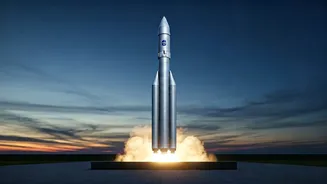









The Rocket That Changes Everything
Named in honour of Dr. Vikram Sarabhai, the father of India’s space program, Vikram-1 is a seven-storey tall, multi-stage launch vehicle developed by Hyderabad-based startup Skyroot Aerospace. It is engineered to carry small satellites, with a payload
capacity of up to 480 kg, into Low Earth Orbit. What makes Vikram-1 a game-changer is not just its technology—which includes an all-carbon composite structure and 3D-printed engines—but its origin. It is India’s first orbital-class rocket designed, manufactured, and launched by a private company. This achievement, culminating in its 'Mission Aagaman' (meaning 'Arrival'), follows the successful suborbital flight of its predecessor, Vikram-S, in 2022, and signals the graduation of India's private space sector from concept to reality.
A Launchpad for a New Economy
Until now, a startup with a brilliant satellite idea had a long and uncertain path to space. They had to either wait for a spot on a large rocket from the Indian Space Research Organisation (ISRO) or look to expensive foreign launch providers. This created a significant bottleneck. Skyroot Aerospace’s Vikram-1 offers a solution often described as a 'space taxi'—a dedicated, on-demand ride for small payloads. This flexibility in scheduling and orbit selection is crucial for the burgeoning small satellite market. By providing a domestic, potentially more affordable launch option, Vikram-1 drastically lowers the barrier to entry for hundreds of companies working on everything from Earth observation and communications to in-orbit manufacturing and data analytics. Suddenly, a business plan that once seemed years away can be executed in months.
The Policy Shift That Opened the Skies
The rise of companies like Skyroot didn't happen in a vacuum. It was enabled by a series of landmark policy reforms that began in 2020, designed to open India’s traditionally state-run space sector to private enterprise. The creation of the Indian National Space Promotion and Authorisation Centre (IN-SPACe) was a pivotal move. IN-SPACe acts as a single-window agency to promote, authorise, and supervise private space activities, allowing startups to use ISRO’s world-class facilities, such as launch pads and testing infrastructure. This symbiotic relationship allows ISRO to focus on large-scale scientific exploration and R&D, while the private sector drives commercialisation and innovation, with the shared goal of growing India's share of the global space economy from about 2% to a projected 8-10% in the next decade.
An Ecosystem Takes Flight
The impact of a reliable private launch vehicle extends far beyond just getting satellites into orbit. It creates a ripple effect, stimulating an entire ecosystem. With accessible launch options, more investment flows into startups developing satellite hardware, ground station services, and downstream data applications. India now boasts over 200 active space startups, with companies like Agnikul Cosmos also developing their own launch vehicles, and others like Pixxel and Dhruva Space focusing on satellite constellations and subsystems. This growing cluster of innovation attracts global attention and talent, creating high-skilled jobs and building a domestic supply chain for everything from advanced materials to avionics. The launch of Vikram-1 is a powerful signal to investors and entrepreneurs that India's space-tech market is ready for commercial liftoff.