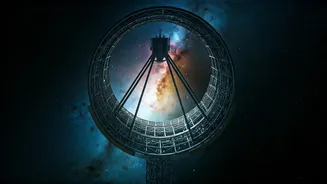







A Legendary Eye on the Cosmos
For over 25 years, the Chandra X-ray Observatory has been humanity’s premier eye on the high-energy universe. Launched in 1999, it is one of NASA’s “Great Observatories,” a quartet of powerful telescopes that transformed modern astronomy. Named after
the Nobel Prize-winning Indian-American astrophysicist Subrahmanyan Chandrasekhar, Chandra has a special resonance and legacy. Its mission is to observe the universe in X-rays, a part of the light spectrum that is blocked by Earth’s atmosphere. This unique capability allows it to see things other telescopes can't, like the superheated gas swirling around black holes, the explosive remnants of dead stars, and the mysterious dark matter that holds galaxies together. With unparalleled resolution, Chandra has contributed to countless breakthroughs, making it one of the most scientifically productive observatories in history.
The Threat Isn't in Space
Given its long and successful career, you might assume Chandra is simply wearing out. But the telescope is healthy, its instruments are working exceptionally well, and it has enough fuel to potentially operate for another decade. The crisis facing Chandra is not technical, but financial. Facing budget constraints, NASA has proposed drastically cutting the observatory's funding. This move would effectively begin the process of shutting the mission down—not because of failure, but as a cost-saving measure. For the global scientific community, the idea of deliberately decommissioning a healthy, multi-billion-dollar asset that is still producing world-class science is almost unheard of and has been met with shock and protest.
A Scientific Outcry
In response to the proposed cuts, a remarkable grassroots movement called #SaveChandra has erupted. Astronomers, researchers, and space enthusiasts from around the world are campaigning to convince policymakers to restore the observatory's funding. Their argument is simple: losing Chandra would be a catastrophic blow to astronomy. It’s a common misconception that new telescopes like the James Webb Space Telescope (JWST) make older ones obsolete. In reality, they are designed to work together. JWST sees the universe in infrared light, while Chandra sees it in X-rays. Combining their data provides a more complete picture of cosmic events. To lose Chandra would be to lose one of our essential senses for viewing the cosmos, and there is no replacement telescope ready to take its place.
The Case for Keeping Chandra
Proponents of the mission argue that continuing to fund Chandra is an incredible bargain. The observatory is a technological marvel that has already been paid for, and its annual operating costs are a tiny fraction—less than 0.3 percent—of NASA's total budget. In return for this small investment, it continues to provide crucial data on everything from the life cycle of stars to the evolution of the entire universe. It supports thousands of jobs and research projects, and its discoveries consistently capture the public's imagination. Scrapping a healthy and productive mission like Chandra, advocates argue, would be a tragic waste of a priceless scientific resource and send a chilling message about the value placed on long-term discovery.
The Future of Space Service
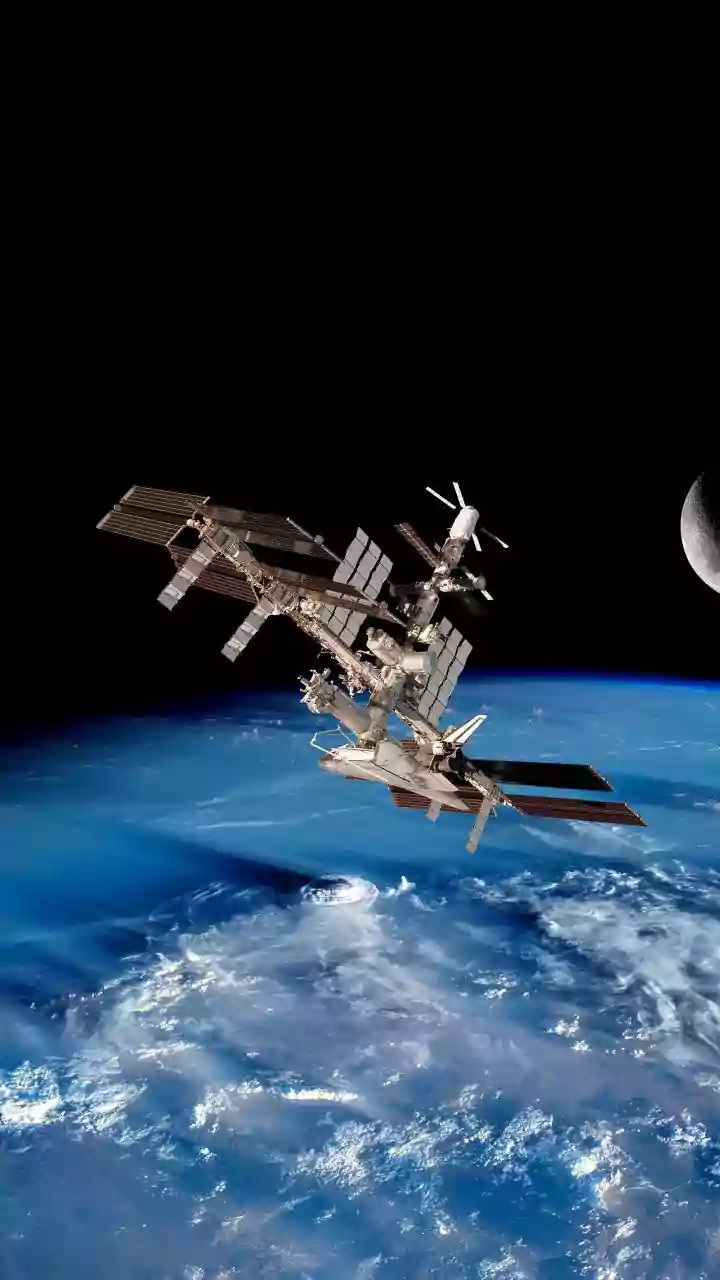
While the immediate battle for Chandra is being fought in budget meetings, it raises a fascinating question about the future. What if we didn't have to abandon our space assets? The headline's promise of 'saving' the telescope points toward an emerging paradigm in space exploration: in-orbit servicing. NASA is already partnering with commercial companies to develop technologies that could one day allow a robotic spacecraft to visit an aging satellite like Chandra. Such a mission could potentially give the observatory a gentle push, or 're-boost,' into a higher orbit, extending its life for many more years. While Chandra wasn't designed to be serviced, the very idea represents a shift from a disposable model of space exploration to a sustainable one, where we maintain and upgrade our most valuable eyes on the sky.